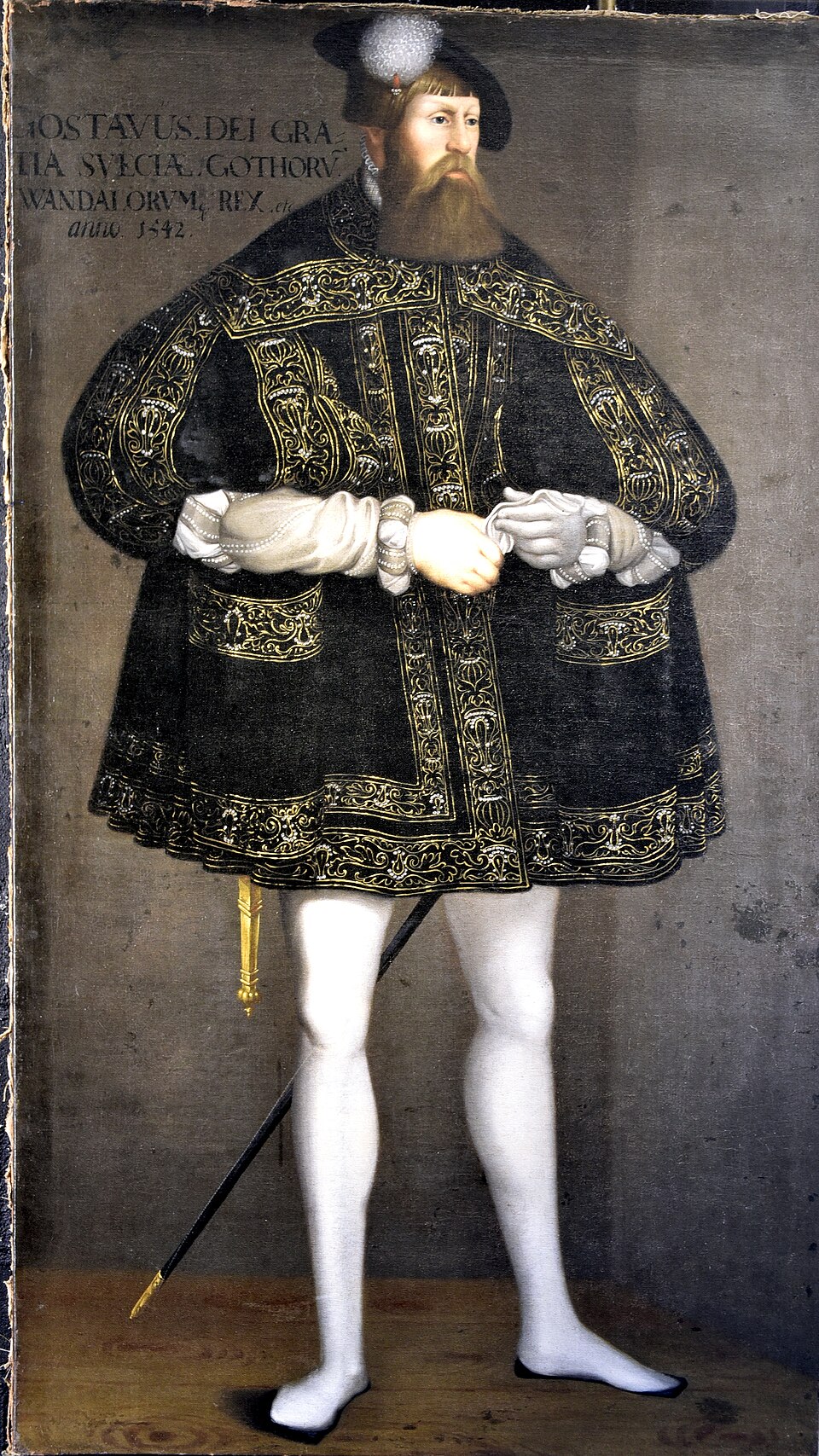
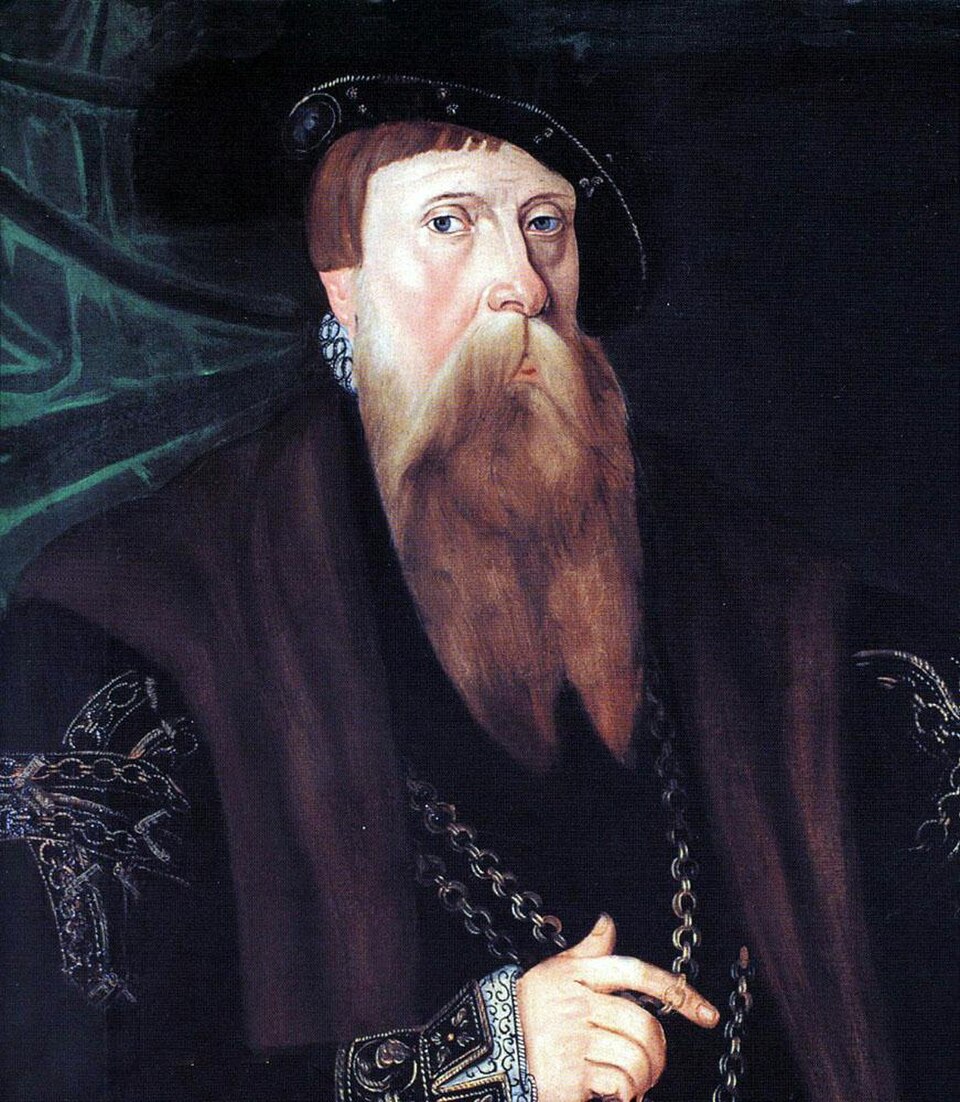
The union that Margrete I had forged at Kalmar, Gustav Vasa broke. A minor nobleman whose father was beheaded in the Stockholm Bloodbath, he came out of the forests of Dalarna at the head of a peasant rising, was elected king in 1523, and held the crown for thirty-seven years without ever loosening his grip. He built the modern Swedish state — its navy, its bureaucracy, its national church — and paid for it with the confiscated silver of the saints and an army of bailiffs that reached into every parish. He is called the father of his country, and by those who felt his hand, a tyrant; the honest answer is that he was both. And the dynasty he raised to outlast him would, within a few years of his death, be torn apart by the very disease he had once fled.
The Bloodbath that made a king
Gustav Eriksson was born around 1496 into the Vasa family — lesser nobility with a sheaf of grain on their arms and a thread of kinship to the Sture regents who led Sweden's resistance to Danish rule. He grew up inside that resistance. In 1518 the Danish king Christian II seized him as a hostage during a truce and shipped him to Jutland; he escaped the following year, made his way through Lübeck, and came home in 1520 to a country about to be broken.
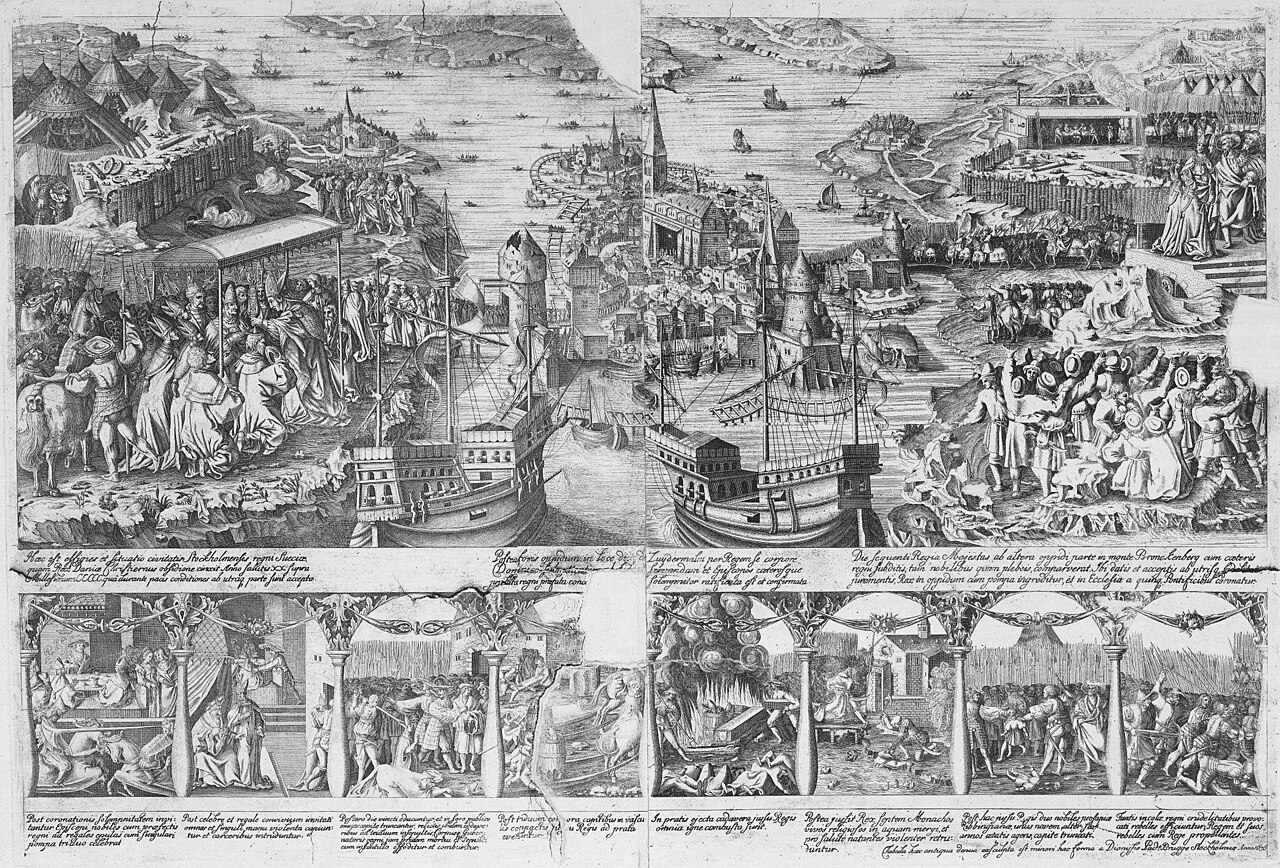
It broke in November 1520. Christian had himself crowned king of Sweden in Stockholm, and after three days of coronation feasting he sprang a trap dressed as a court of law: a tribunal condemned the leading men of the realm as heretics, and over the 8th and 9th of November some eighty to a hundred nobles, bishops and burghers were beheaded in the main square. Among the first to die was Gustav's father, Erik Johansson. His mother and two of his sisters were carried off to a tower in Copenhagen and died there — not under the axe, as the legend later told it, but of plague, in the winter of 1522–23. This is the documented horror, and it is colder than the myth: not a banquet betrayed, but a kingdom's elite tried and killed by law.
Out of the forests of Dalarna
He ran north, into the snow and forests of Dalarna, a hunted man with a murdered father and nothing left to lose. There he set out to raise the one force the Danes could not buy: the free peasants of the mountains. By the start of 1521 they had made him their commander, and the rising that would free Sweden had begun.
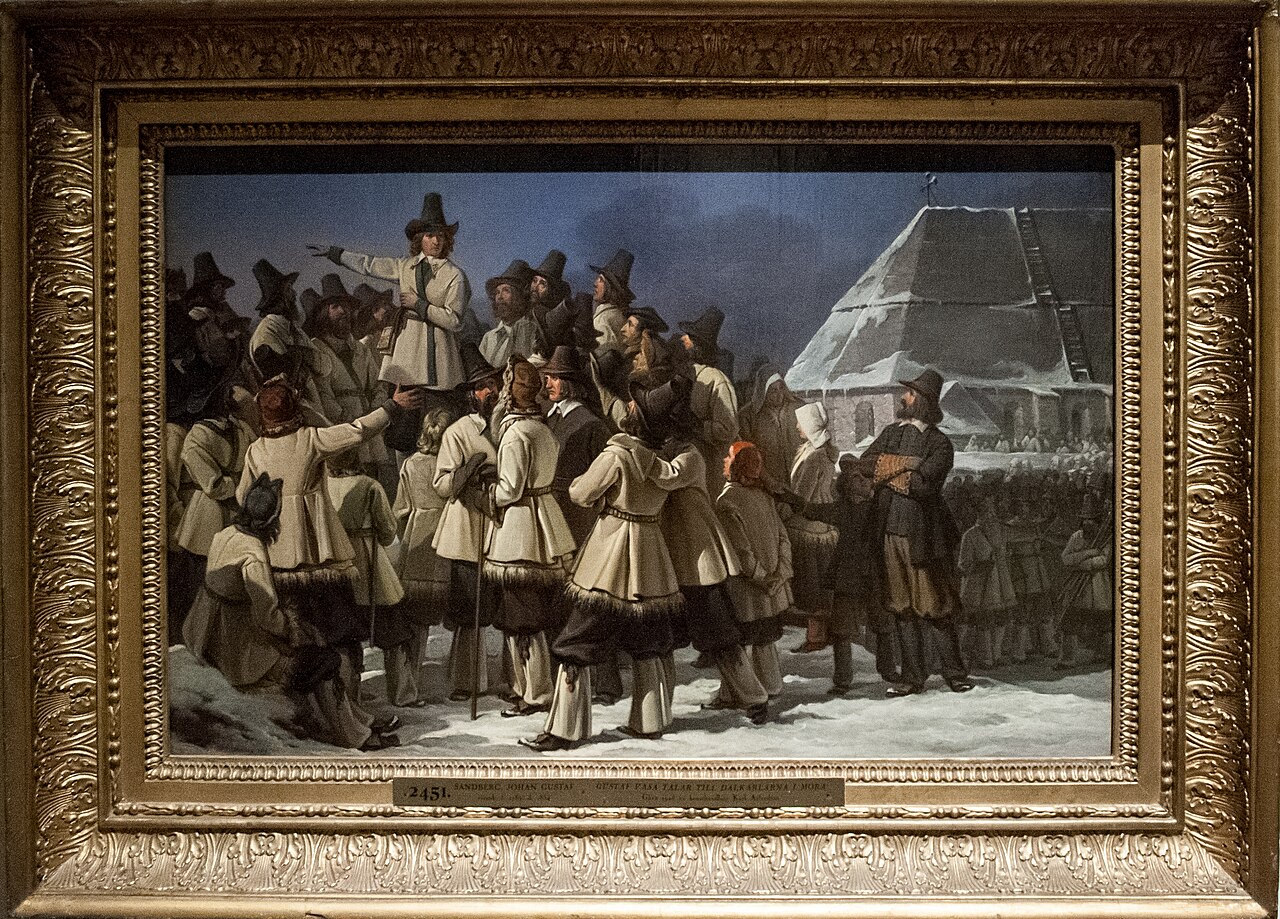
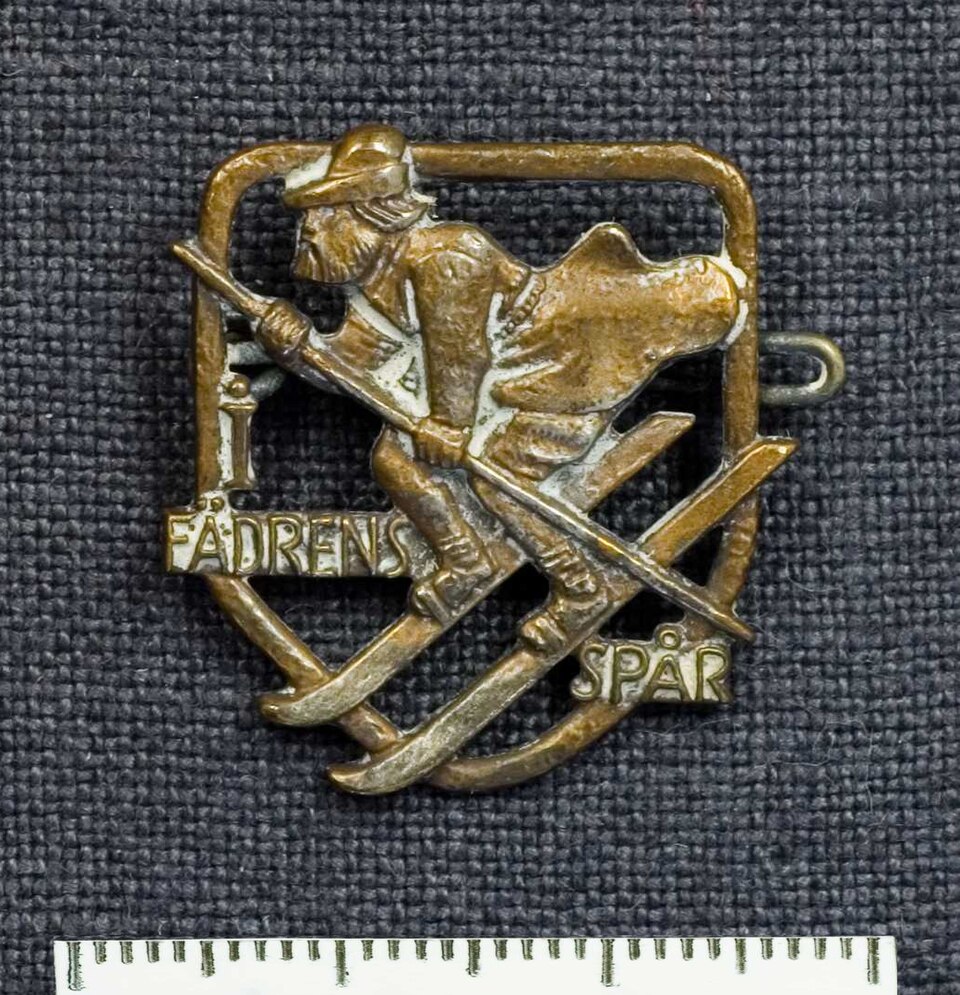
Everything else you may have heard about those weeks should be held at arm's length. The vivid story — that the men of Mora turned him down, that he set off on skis toward Norway and exile, that they thought better of it and sent their fastest skiers to overtake him at Sälen and bring him back; the nights hidden under straw in a cart, lowered through a privy at Ornäs, saved by a farmer's wife — comes down to us almost entirely through a chronicle Gustav himself commissioned forty years later, embroidered further by writers of the 1600s and the national-romantic 1800s. The near-contemporary sources speak of snowshoes, not skis. Sweden still races that flight every winter, from Sälen to Mora — the reverse of the way he is said to have fled; the race was founded in 1922. What is certain under all the embroidery is only this: the countryside rose, and it rose for him. He was twenty-five, and he had already learned the two lessons he would rule by — trust no one, and own the telling.
A kingdom bought on credit
The war was won on borrowed ships. Lübeck and the Hanseatic League supplied the rebels with vessels, cannon, soldiers and loans, in exchange for trade privileges — and the weight of that backing put the Danes out of Stockholm, which surrendered in June 1523. On the sixth of that month, at Strängnäs, the assembly elected Gustav Eriksson king of Sweden; he rode into the city at midsummer. The hunted man of 1520 was Gustav I, and 6 June — the date of his election — is the day Sweden still keeps as its national day.

But a kingdom bought on credit comes with a creditor. The Lübeck debt would hang over the whole first decade of his reign, and the bill, when he finally forced his subjects to pay it, would set the country alight. He had been elected, not yet crowned — that waited until 1528 — and elected to a treasury that was empty and owed. He began at once to look for money, and he found it where the wealth of the North was kept: in the Church.
The silver of the saints
At the assembly of Västerås in 1527, Gustav broke Sweden from Rome — not as a man wrestling with his soul, but as a man reading a balance sheet. The Church held perhaps a fifth of all the land in Sweden, against the crown's own twentieth, and he took it: the estates, the rents, the treasure, the very bells of the parish churches, and he made the clergy pensioners of the state. The reformers Olaus Petri and Laurentius Andreae supplied the theology, preaching that the Church's wealth belonged by right to the people; Gustav supplied the will, and kept the silver. By every sober reading the Swedish Reformation was a fiscal revolution first and a religious one second.
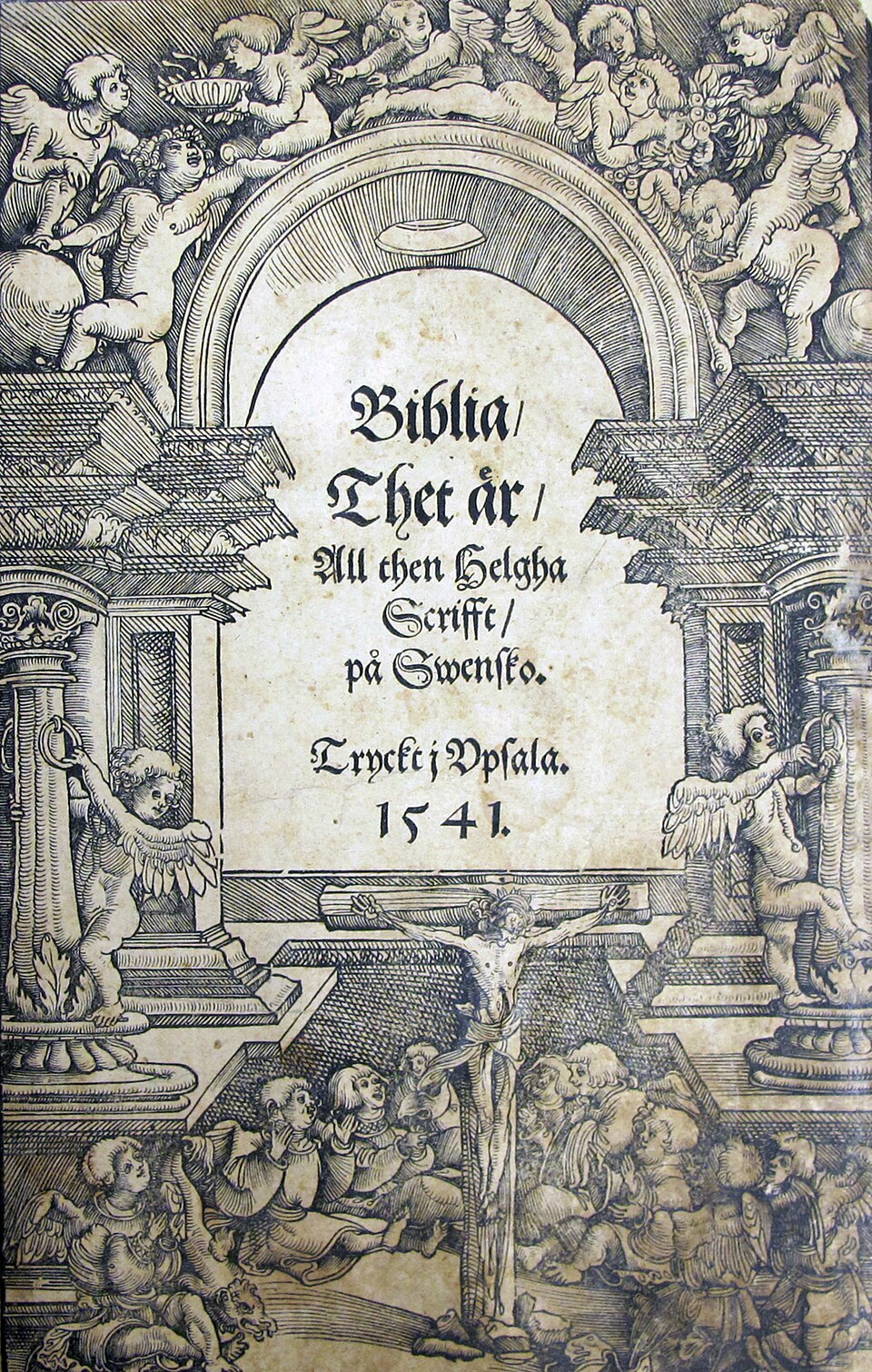
What it left behind was, against the king's intentions, a lasting gift. To root the new faith he had the Bible put into Swedish, complete, in 1541 — the Gustav Vasa Bible, translated from Luther's German and printed in Uppsala by a craftsman fetched from Lübeck. It was the only complete Bible printed in Sweden in the whole century, and it did more than carry the gospel: it fixed the shape of the written language, its spelling and its letters, for four hundred years. The man who wanted the Church's money gave the country its prose.
Bells, silver and the axe
The bill for all of it came due in the countryside, and the countryside did not pay quietly. When Gustav demanded that each parish surrender its largest church bell to settle the Lübeck debt, the men of Dalarna — the same men who had made him king — refused. The Bell Uprising of 1531 to 1533 was the most dangerous of several revolts against him, and it taught the country what kind of king it had made. He offered the rebels grace, accepted their submission, and then, once he was sure of his ground, had their leaders seized and executed — among them Måns Nilsson and Anders Persson, men who had sheltered him in the snow ten years before. He governed by a method he would use again and again: promise mercy, secure the advantage, bring down the axe.
The greatest reckoning came in 1542. In the forests of Småland a yeoman named Nils Dacke raised the most dangerous peasant rising in Swedish history — against the taxes, the bailiffs, the seized church silver, the ban on trade across the Danish border, the foreign Lutheran service forced on Catholic villages. For one winter Dacke ruled most of southern Sweden, reopened the old churches, and forced the king to a truce. Gustav broke the truce as soon as the season turned, crushed the rising in the winter battles of 1543, hunted Dacke down, and had his quartered body displayed at the borders of the realm he had nearly taken. It was the nearest Gustav ever came to losing everything — and it convinced him that an elective crown was a crown a man could lose.
The crown made hereditary
Out of the terror of the Dacke War came the most consequential act of his reign, and the quietest. In 1544, at Västerås, Gustav had the estates agree that the crown of Sweden — elective since the Middle Ages, a thing the council could grant and withhold — would pass by blood to his sons, and their sons after them. At a stroke he turned a kingdom into an inheritance and founded a dynasty. The House of Vasa would hold the throne for more than a century, down to the queen who abdicated it in 1654.
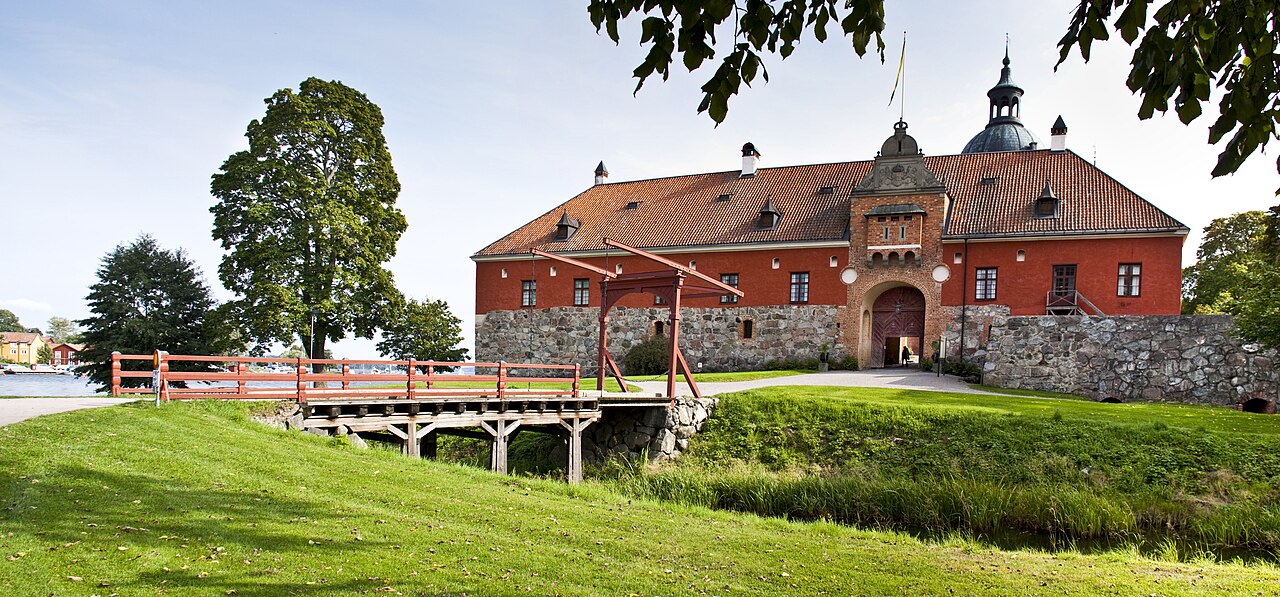
Underneath the drama, this was always the real Gustav: an administrator of cold genius. He built a standing navy, the first fleet answerable to the state rather than to nobles and cities. He filled the chancery with German officials who ran the realm like a counting-house, and he multiplied the bailiffs who gathered his taxes — from a few dozen at his accession to more than two hundred at his death — each a crown man reaching past the nobility into the parishes, every farm and its dues written down in his ledgers. The red-brick castle he raised for himself on Bo Jonsson Grip's old island, Gripsholm, and the Renaissance fortress he wrapped around the medieval walls of Kalmar, were the visible corners of an invisible machine: the modern Swedish state, run from a strongbox.
The king who wrote his own story
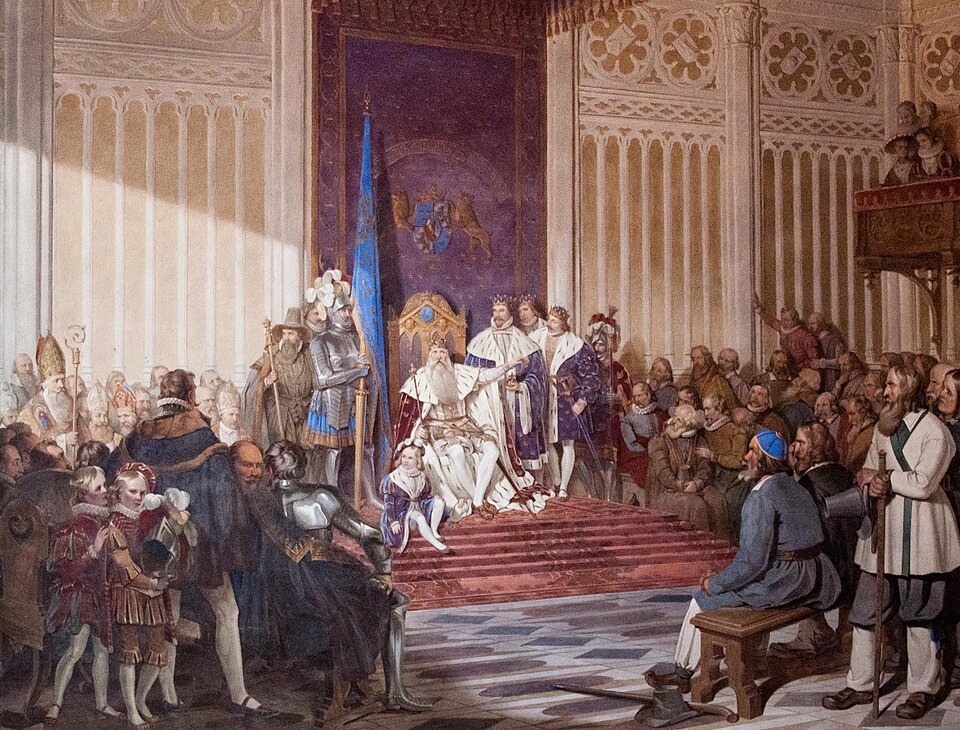
Gustav Vasa died on 29 September 1560, almost forty years a king, and was laid in a great tomb in Uppsala Cathedral between two of his three wives. At his last meeting with the estates that summer he had his testament read aloud and spoke in his own defence, reviewing the whole long reign. The speech is famous and much quoted — and only fragments of it actually survive, preserved through the chronicler he himself had commissioned. It is the fitting last act of the man: even his farewell reaches us in the version he wanted remembered.
.jpg)
He had made the crown hereditary to spare Sweden another bloodbath. The irony was waiting in his own house. The crown passed to his eldest son, Erik XIV, and within a few years the brothers were at each other's throats — Johan locked in a tower at Gripsholm, then Erik shut away and poisoned after him. The line he had built across a lifetime to protect itself was torn apart from within by the very disease he had fled: suspicion, betrayal, his own blood against itself.
And there is a longer symmetry. A century and a quarter before him, Margrete I had gathered all three Nordic crowns into a single union and crowned a boy-king at Kalmar to hold them together. Gustav Vasa was the man who pulled Sweden out of that union for good. The North she had bound into one, he helped break into the shape it still keeps. The founder of modern Sweden was, just as truly, the undoing of her life's work.