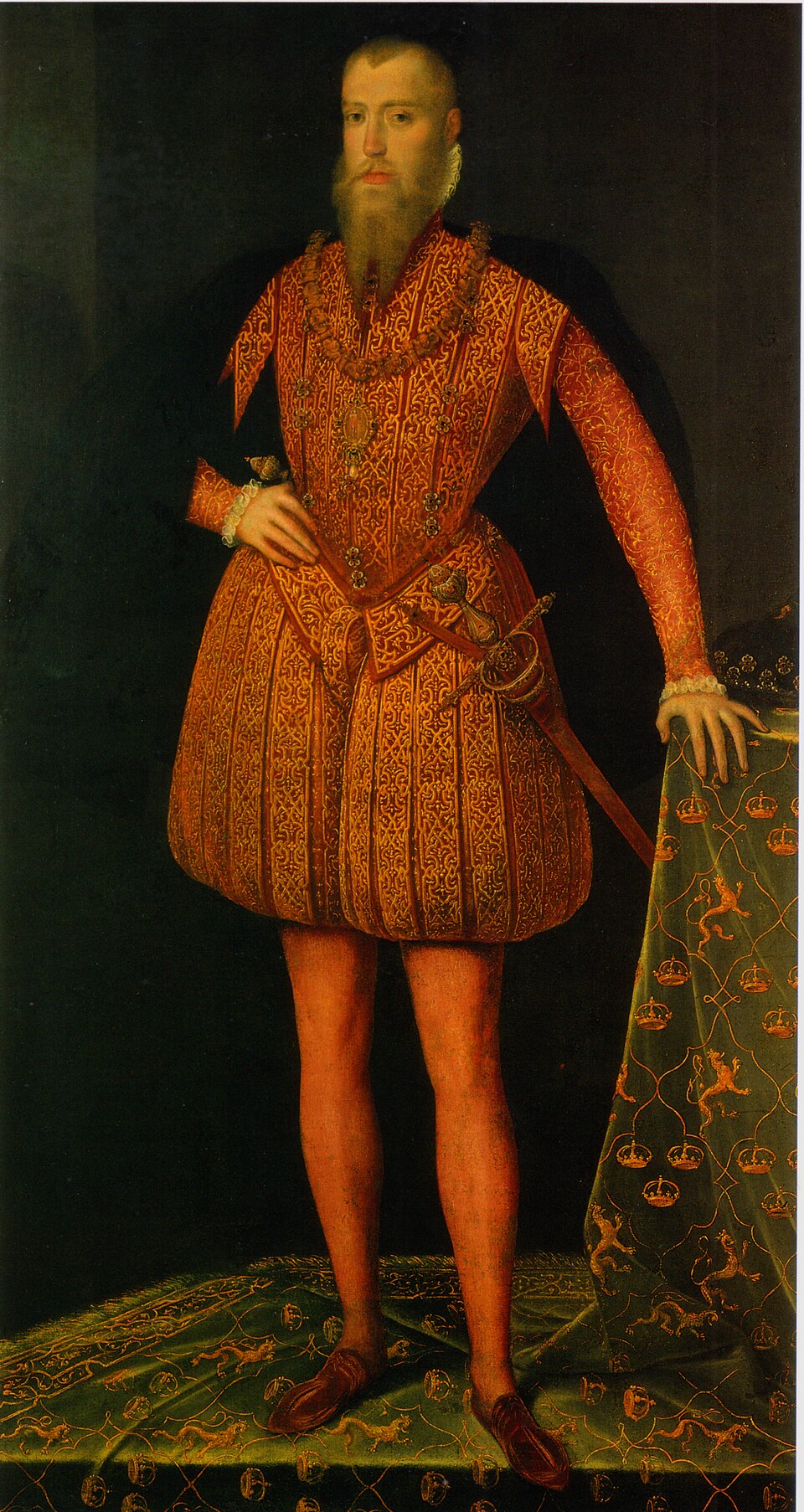
He was the most gifted of Gustav Vasa's sons, and the most ruined. Erik XIV came to the throne in 1560 a true Renaissance prince — Latin and French, drawing and astrology, an ambition that reached for the Baltic and for the hand of Elizabeth of England — and he inherited, with the crown, his father's bottomless suspicion. Within seven years it had curdled into something murderous: he stabbed a nobleman in his cell, lost his reason, married a jailer's daughter and set the crown on her head, and was toppled by his own brothers. He died in a locked room with arsenic in his body. He is the tragedy the dynasty was built to prevent — the Vasa blood turning, exactly as his father had feared, against itself.
The most gifted of Gustav's sons
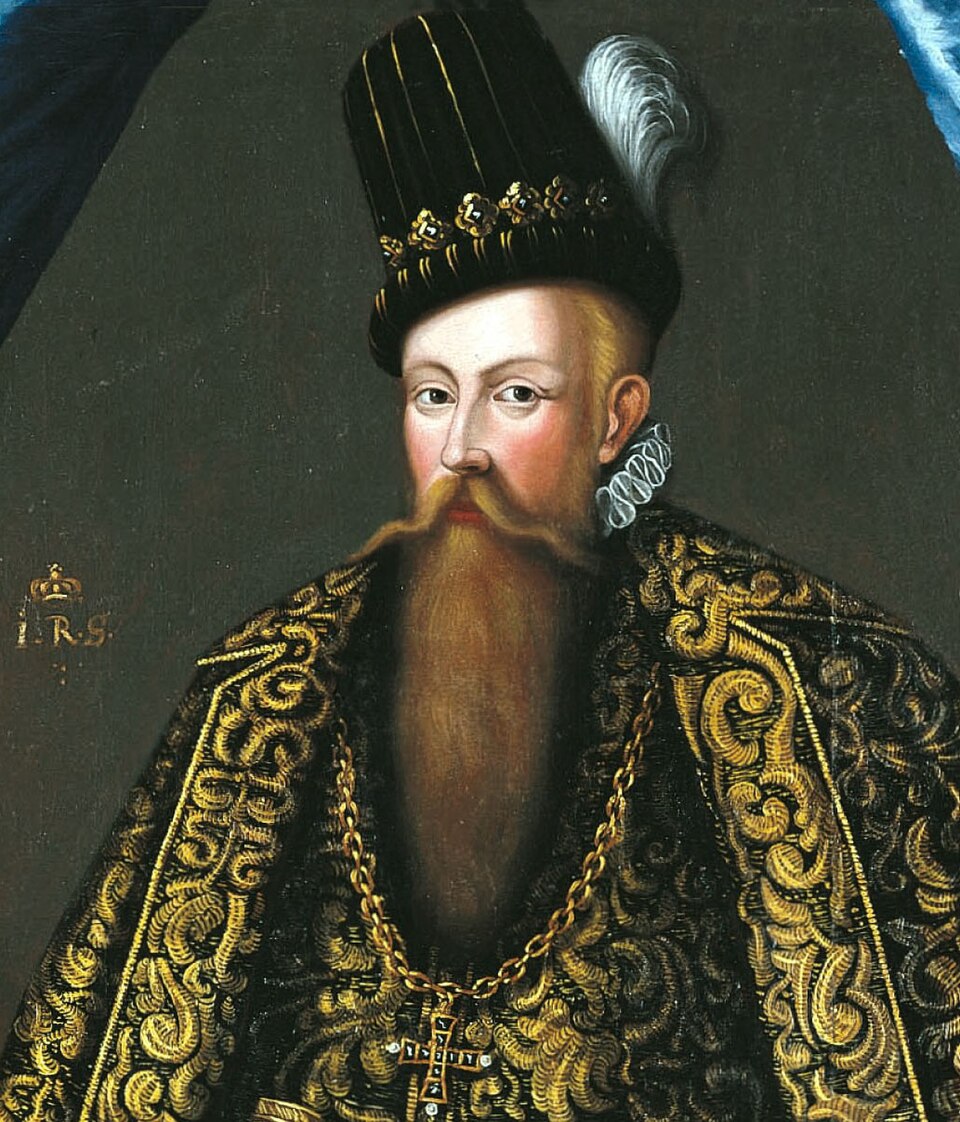
When Gustav Vasa died in 1560, the crown he had made hereditary passed, as he intended, to his eldest son. Erik was twenty-six, and on paper the finest king the young dynasty could have hoped for: he read and wrote Latin, German and French, studied history and mathematics, cast horoscopes, and drew — his pen sketches in the margins of his books are among the earliest we have from a named Swedish hand. He was also a serious and ambitious ruler. He curbed the near-sovereign duchies his father had granted his younger brothers, built a high court to bring the great nobles to heel, pushed Swedish power across the Baltic to take Reval and Estonia in 1561, and led his realm into the long Northern Seven Years' War against Denmark.
._Nationalmuseum%2C_Stockholm%2C_Sweden.jpg)
But he had inherited more than the crown. His father's defining trait — a suspicion that trusted no one and saw treason in every powerful man — ran in Erik undiluted, and in him there was no Gustav's iron control to hold it. The same gifts that made him brilliant made him volatile. From early in the reign, those closest to him saw a mind that could turn.
The suitor of queens
Before the darkness, there was a courtship that lit up half of Europe. From his years as crown prince, Erik set his heart on the greatest match imaginable: Elizabeth I of England. He wrote her love-letters in Latin, sent embassy after embassy, had a full-length portrait of himself painted and carried across the North Sea, and twice made ready to sail to England in person — only to be turned back, once by his father's death, once by storms. Elizabeth kept him dangling for the diplomatic leverage and married no one. By 1562 the suit was dead.
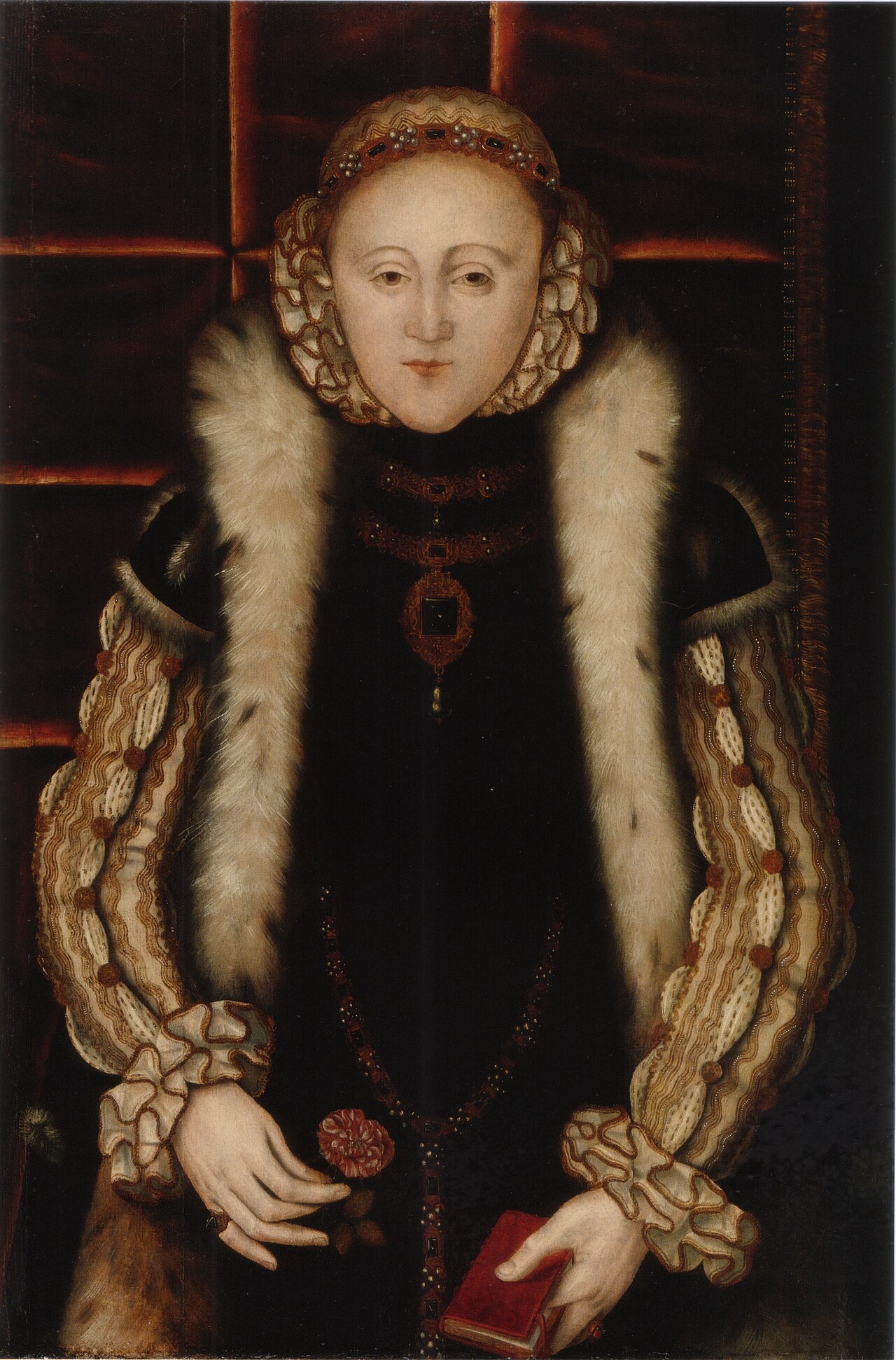
He turned to others with the same restless hope and the same result: Mary, Queen of Scots; Christine of Hesse (broken off, the story goes, after one of his letters to Elizabeth fell into the wrong hands); Renata of Lorraine; Anna of Saxony, who married William of Orange instead. He courted half the crowned women of Europe and won not one of them. In the end the king who had reached so high married the lowest-born woman at his court — and that is its own story, and the beginning of his fall.
Göran Persson and the gathering fear
The instrument of Erik's suspicion was a low-born man named Göran Persson — a priest's son, Wittenberg-educated, sharp and ruthless, whom the king made his prosecutor in a new royal high court. Through Persson, Erik turned the law against the great families: charges of treason, fines, death sentences, a web of informers. To a nobleman, the sound of the king's name began to carry dread. The old aristocracy had bent the knee to Gustav Vasa; his son meant to break them, and he had found the man to do it.
His fixation settled on the Stures, the proudest of the old families, whom he feared as rivals for a throne he had no legitimate son to secure. In 1566 he had Nils Sture paraded through Stockholm on a broken-down nag wearing a crown of straw — a public humiliation dressed as justice. It was a rehearsal. The real thing came the following spring, and it would cost Erik his reason.
The Sture Murders
On a day in late May 1567, at Uppsala Castle, Erik went down to the cells where the Sture men and other nobles were held on charges of treason that lived mostly in his own head. What happened there is half documented and half nightmare. He knelt before old Svante Sture as if to beg forgiveness, left, and came back transformed. He drew a dagger and stabbed Nils Sture himself; his guards finished the killing, and when it was done five noblemen lay dead — Svante Sture and his sons Nils and Erik among them. That same day his old tutor Dionysius Beurreus, who tried to calm him, was cut down too. He gave an order to spare 'Lord Sten', and because no one knew which of two Stens he meant, both were left alive — a detail later writers loved, though the record for it is thin.
.jpg)
Then his mind simply gave way. He fled the castle, and for days the King of Sweden was lost — found at last in a village dressed as a peasant, confused and broken. He would not be himself again for half a year, while his council governed in his place. He had killed by his own hand and then unravelled; later ages would call it madness and reach for clinical names, but no diagnosis at four centuries' distance is safe. What is certain is that something in him broke that May, and never fully mended. The one person who could quiet him was a girl from the lowest rung of his court.
A jailer's daughter for a queen
Her name was Karin Månsdotter, and she was as far beneath a king as it was possible to be: the daughter of a common soldier turned jailer, a servant in a court musician's household, perhaps fifteen when Erik first noticed her. (The fond story that he spotted her selling nuts in a Stockholm square is a legend; the truth is plainer, and just as unlikely a path to a crown.) She became his mistress, bore his children, and — alone among everyone at court — could calm him when his mind turned. In the wreckage after the Sture murders, she was the thing he held onto.
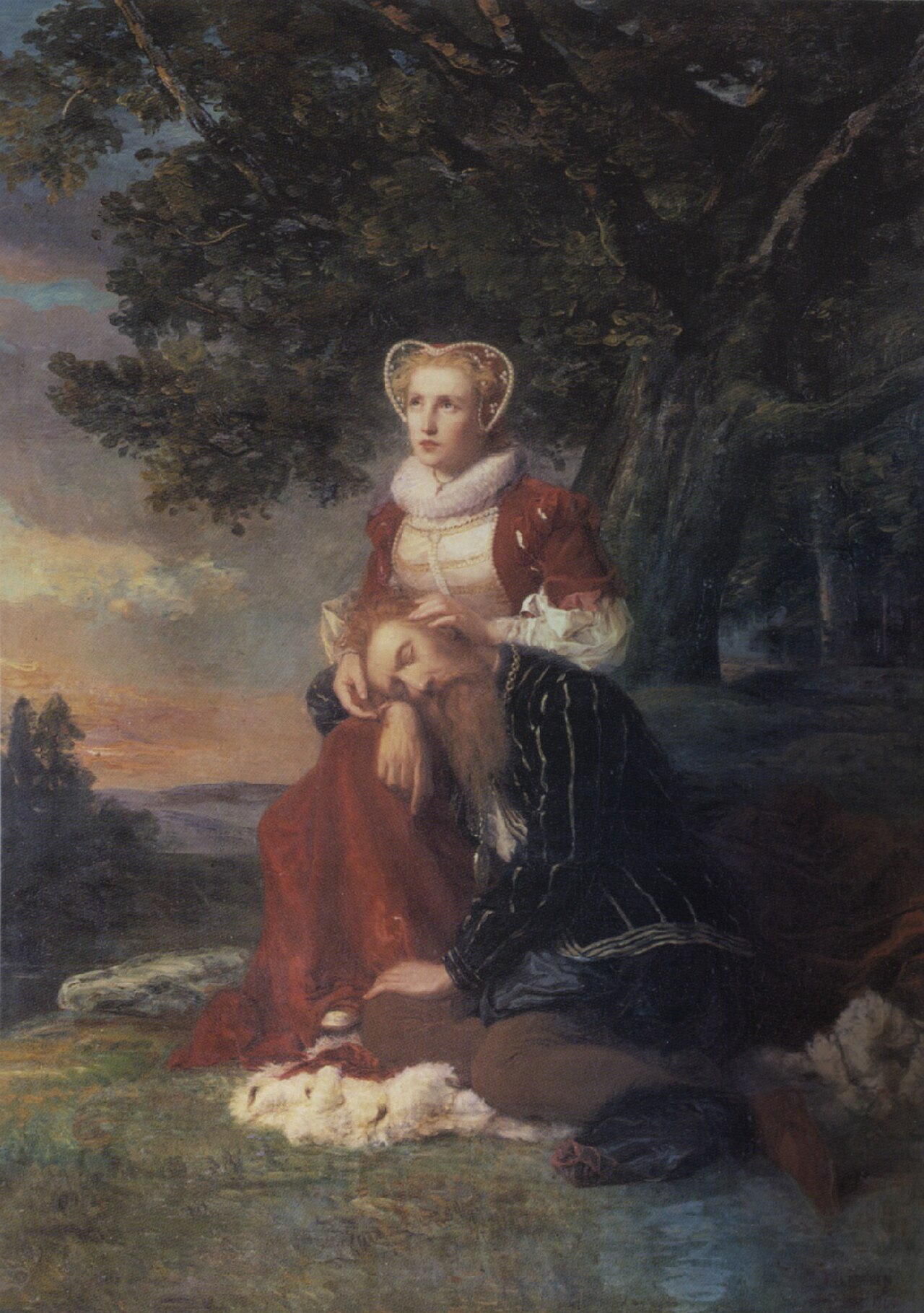
And then he did the unthinkable. In secret first, and openly in the summer of 1568, Erik married her and set the crown of Sweden on her head. A jailer's daughter, queen. To a nobility he had already terrified and bled, a servant girl crowned over them was the final insult — proof, if they needed it, that the king was beyond reason. Her own long story belongs to her; here it is enough to say that loving Karin, and crowning her, was the last free choice Erik made, and the one that sealed his fall.
His own blood
The brothers Gustav Vasa had bred to secure the line now turned it inward. Johan, the half-brother Erik had besieged and jailed in 1563, was free again; he joined the youngest brother, Duke Karl, and together they raised the furious nobility in revolt, declaring the king insane — which by 1568 was less an accusation than a verdict half the realm agreed with. Erik won the one pitched battle he commanded, at Botkyrka, and failed to press it. His own men handed Göran Persson to the rebels, who broke him on the wheel. In late September 1568 Stockholm opened its gates, and Erik surrendered to the brothers he had wronged. The estates made it law the following January: he was no longer king. Johan was Johan III.
It was the exact catastrophe his father had built the hereditary crown to prevent — the Vasa blood turning on itself, brother against brother, precisely the disease Gustav Vasa had fled in the Bloodbath and tried to wall out forever. The wheel came full circle: the brother who had done the jailing was now the jailed.
The arsenic and the cathedral
Erik spent his last eight years a state prisoner, moved from castle to castle — Stockholm, Turku, Kastelholm, Gripsholm, Västerås, and finally Örbyhus. He was not forgotten, which was the danger: as long as he lived, he was a banner for revolt. So Johan III signed a standing order — countersigned by councillors and bishops — that if anyone tried to free him, his guards were to end his life with a drink of opium or mercury. In the end they did not wait for a rescue. On 26 February 1577 Erik died at Örbyhus, forty-three years old.

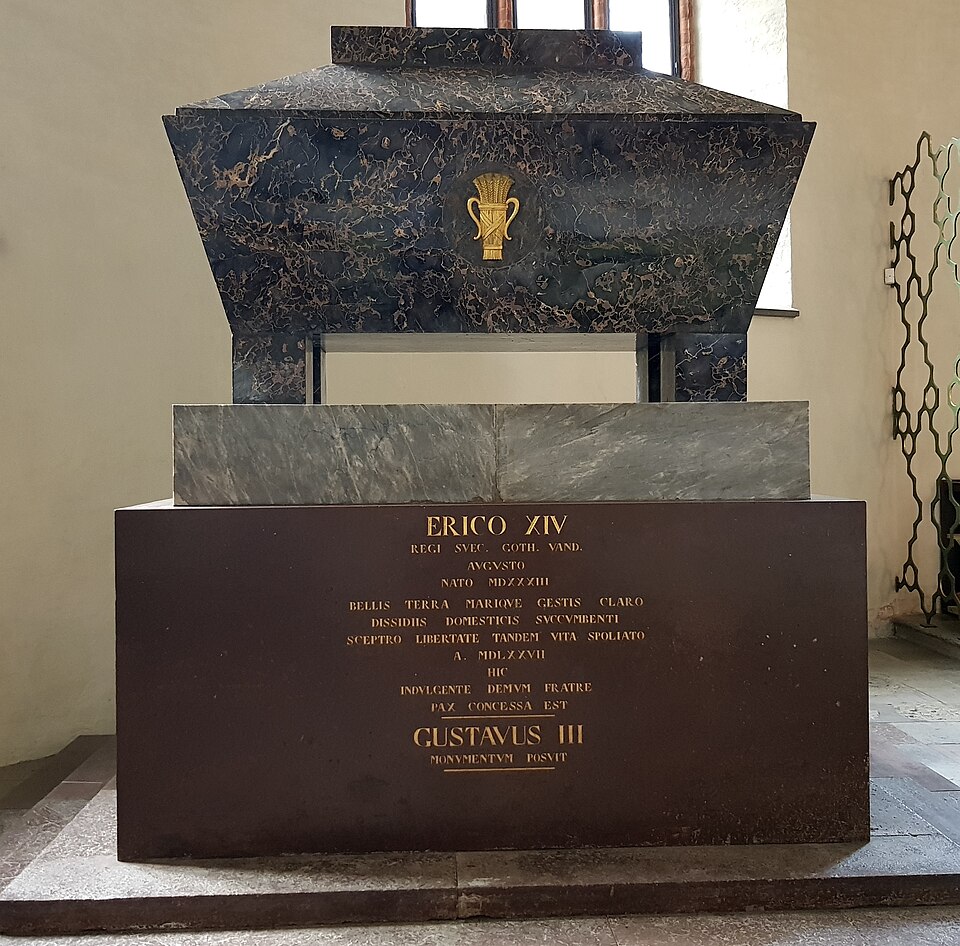
The famous story gives him a bowl of poisoned pea soup, but that is a later embroidery; the truth is both vaguer and harder. When his grave was opened in 1958, his remains held a heavy dose of arsenic — proof that he was poisoned, even if it cannot name the hand or the cup. He was buried in Västerås Cathedral, where a black marble tomb raised two centuries later still holds him. The most gifted of Gustav Vasa's sons, the prince who courted Elizabeth and could draw and reason in three languages, ended as a measured dose of poison in a locked room — undone, exactly as his father had dreaded, by his own blood. The dynasty survived him. It simply ate one of its own to do it.