The hill where kings were made
Climb the rock they call Slottsfjellet — Castle Mountain — and stand at the ledge where it drops to the fjord, and you are standing on the oldest ground in Norway. The town below you, Tønsberg, was old before there was a Norway to hold it. The sagas place it here before the year 871 — before Harald Fairhair won the sea-fight at Hafrsfjord and hammered the small kingdoms into one. For a long time that was only a story the sagas told. Then, in 1987, they dug beneath the old monastery and found the Viking graves still waiting, exactly where the story said they would be.
But age is the smallest part of it. This was the seat of the Ynglings — the half-legendary first dynasty, the line from which Harald Fairhair himself claimed his blood. And on the burial mounds at Haugar stood the Haugating: one of the assemblies where a king of Norway was not born but made — raised up and proclaimed before the judgment of free men. Before a crown was a thing you inherited, it was a thing this ground conferred. Stand on this hill, and you stand at the cradle of the Norwegian crown itself.
The impossible king
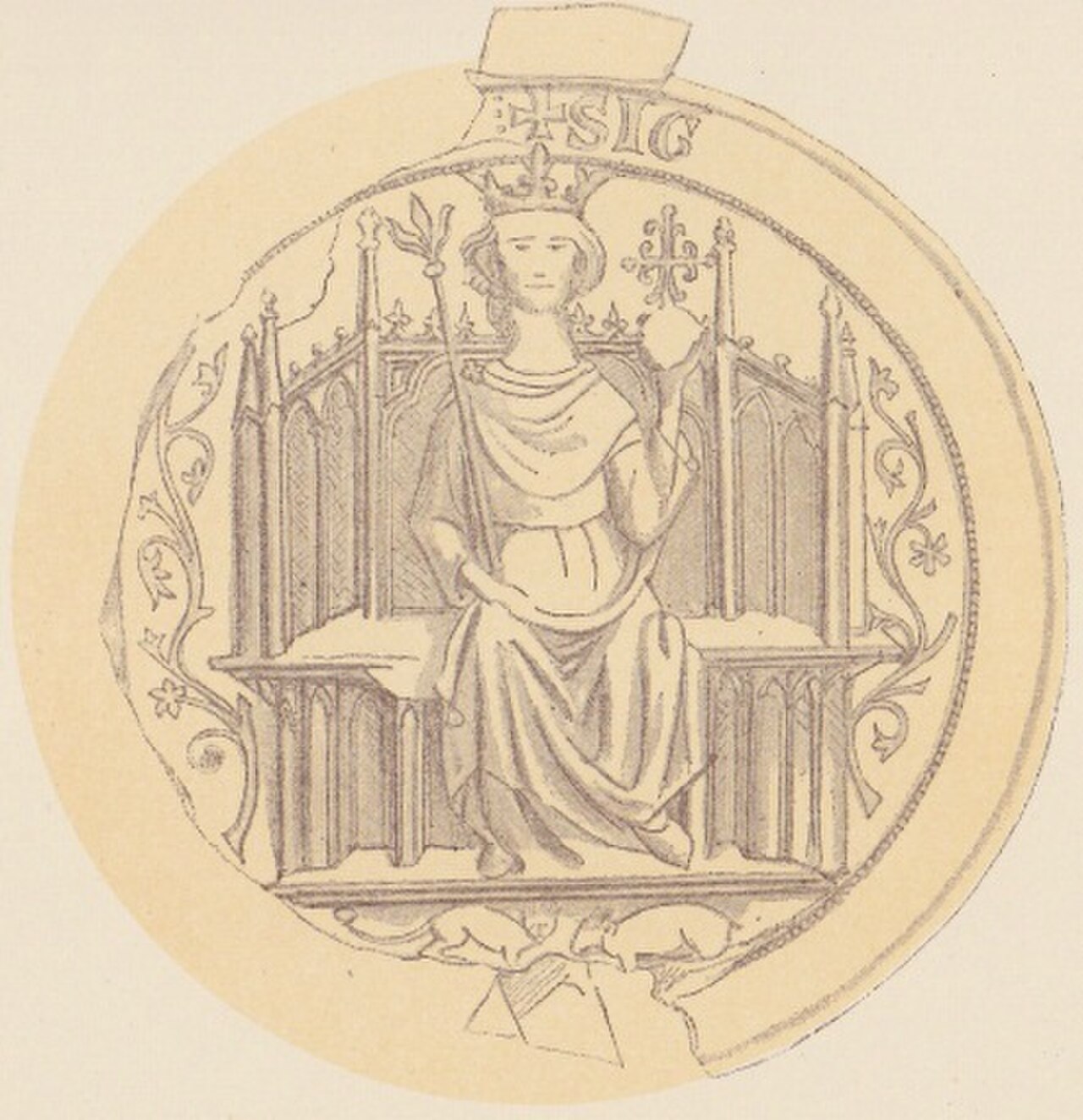
Every story this hill tells is about a king being made — and the strangest king of all began as a priest. Sverre Sigurdsson was raised far out in the Faroe Islands, in a bishop's household, and ordained young; by every appearance he was a clergyman at the edge of the world. Then his mother told him a secret: that his true father had not been her husband, but a dead king of Norway, Sigurd Munn. The claim could never be proved, and many never believed it. It didn't matter. The priest set down his book, crossed the sea, and went to make himself a king.
What he found to work with was a lost cause. The Birkebeiner — "birch-legs" — were a rebel band so poor they bound birch-bark round their shins for want of shoes: the remnant of a beaten rising, leaderless and hunted. In 1177 this penniless priest took command of them. On paper it was absurd — a pretender of unprovable blood leading a starving rabble against King Magnus Erlingsson and the whole weight of the realm.
And he won. Not quickly and not cleanly, but he won. He drilled the rabble into something deadly and out-thought everyone sent against him: at Kalvskinnet in 1179 the old regent Erling Skakke, Magnus's father, was cut down; and in 1184, in the narrow Sognefjord at Fimreite, Sverre's ships broke the royal fleet and King Magnus himself went into the water and drowned. The priest from the Faroes was king of Norway — he had, simply by refusing to accept the world as it was, made the impossible thing true.
The crown bought him no peace. Sverre ruled like a man who answered to no one, and the Church decided he should answer to it. He quarrelled with the archbishop, and in 1194 the Pope excommunicated him; four years later Rome laid all Norway under interdict — in the eyes of Rome, the priest-king was now damned. His side fired back with a remarkable tract, *A Speech Against the Bishops*, arguing that a king's power came from God himself and not through the hands of priests. But Rome had raised a fresh enemy against him — the church-backed Bagler — and the war ground on into his old age.
Which brought him, at the very end, to this rock. In the autumn of 1201 one of the ablest Bagler captains, Reidar the Messenger, took to the heights of Tunsberg with his men — up on this hill, behind its walls and its sheer drop, where even Sverre could not simply storm them. So the old king did the one thing the hill forces on every attacker: he sat down beneath it and waited. Through five months of winter he held the siege, in the cold and the dark, until hunger did what assault could not and the defenders came down off the rock.
He had taken the hill. But somewhere in those five frozen months the king who had outlasted everyone took ill. He sailed for Bergen and did not recover; on 9 March 1202, Sverre Sigurdsson was dead. The priest who had willed himself from the edge of the world onto the throne of Norway — who had broken regents and kings and defied the Pope of Rome — was undone at the last by a hill and a winter. The rock that makes kings had, this time, unmade one. But the house he had fought into being would hold Norway's throne for another hundred years — and it would come back to this hill to die.
.jpg)
The castle
The house Sverre fought into being nearly died in its cradle. His son held the throne barely two years; and when that son died too, the heir was a baby — Håkon Håkonsson, born after his own father was already dead, the one life the church-backed Bagler most wanted to end. In the winter of 1206 two of his father's old Birkebeiner carried the infant on their backs across the mountains on skis — a desperate two-hundred-kilometre flight through the snow to get him beyond the enemy's reach. (Norway still races it every year.) The child lived. And he grew into the king who did what even Sverre could not: he ended the wars. A century of Norwegians killing Norwegians stopped under Håkon IV, and the country he steadied opened into its golden age — the years when Iceland and Greenland came under the Norwegian crown and the kings of Europe wrote to the grandson of the birch-leg priest as an equal.
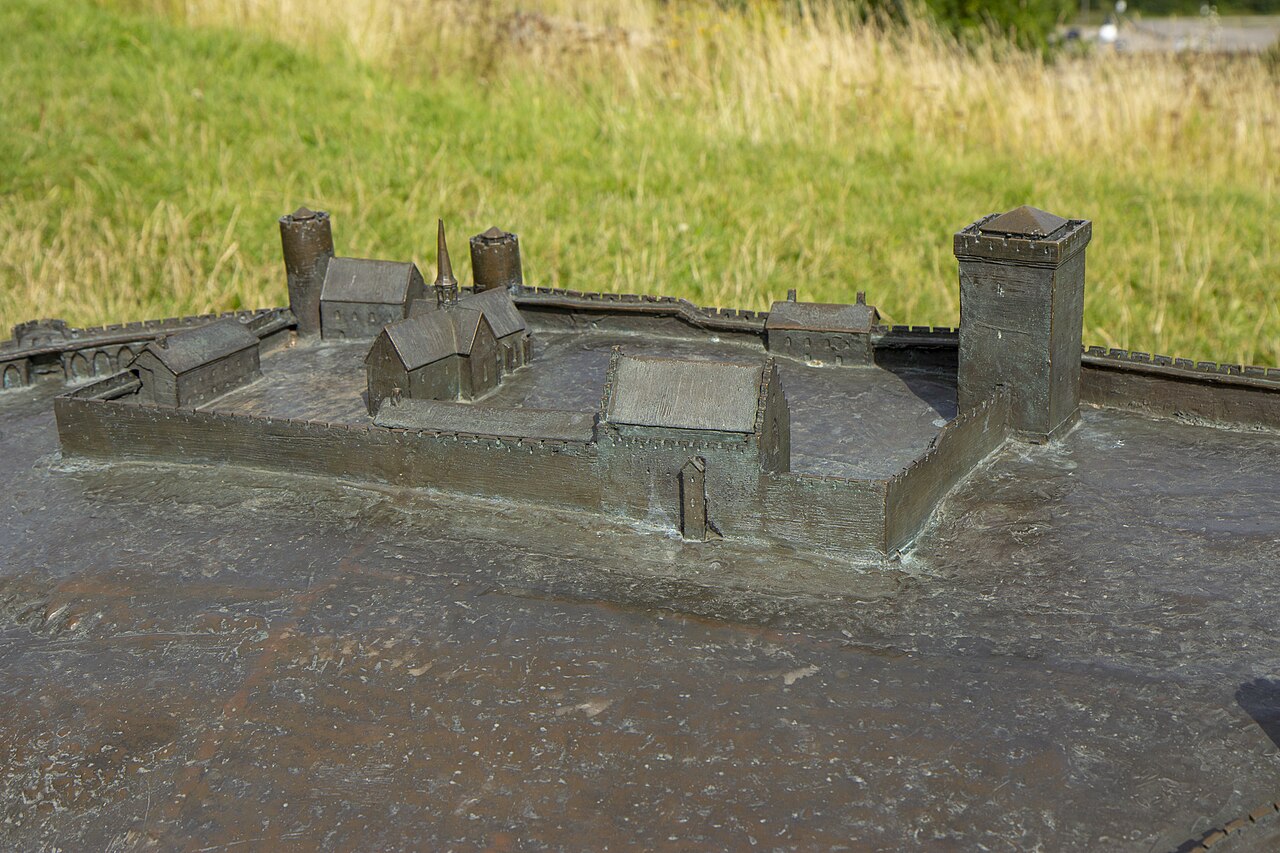
And here, on his grandfather's hill, Håkon built to match. Where Sverre had only besieged the rock, Håkon and his son Magnus the Lawmender raised a true castle on its crown — Castrum Tunsbergis — and grew it into the largest in all of Norway: a great wall thrown clear around the summit, set with towers, holding royal halls and storehouses and a church. From the hill where free men had once made a king with a shout, you now looked down on one of the busiest harbours in the North — and up at walls that held, in sheer stone, what this ground had once granted by acclaim.
The last of the old line
The hill that made the impossible king kept one last appointment with his house. In 1319 an old and failing king climbed to Tunsberghus and did not come down again. His name was Håkon V Magnusson, and he was Sverre's own blood — the last male heir of the house the priest-king had fought into being, a century before, on this very rock. Twenty years earlier, far to the north at the mouth of Oslo's harbour, Håkon had set masons building a fortress called Akershus, to guard Norway's future. Now he came, at the end, to die on the hill that had cradled its past.
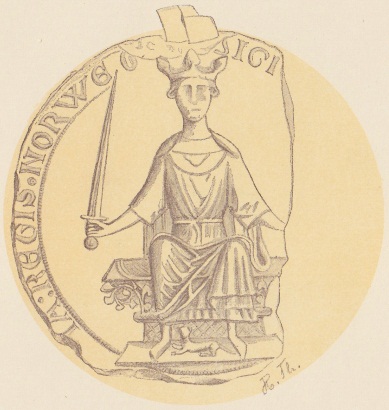
And with him the old royal line of Norway ran out. The blood that ended in Håkon V reached back — in fact and in fierce claim — through Harald Fairhair to the half-legendary Ynglings, the very kind of kings this hill had first raised by acclaim. Sverre had dragged that line back from the edge of nothing; the Birkebeiner had carried it over the winter mountains on their backs; Håkon IV had given it the greatest castle in the land. And now it simply ended — no son, only a daughter, and one old man's last climb up a hill. The rock that made Norway's kings had become the deathbed of the last of them.
Through that daughter the crown slipped away for good. Her son, Magnus Eriksson, would wear Norway and Sweden at once — the first of the great Nordic unions — and from that day Norway never again stood wholly on its own. And there is a last, almost gentle turn: in 1335 that same grandson was married on this rock, and gave the old castle to his bride as a wedding gift. An ending and a beginning on the same hill — the death of the old blood, the rise of the union age. Tønsberg had made the first kings of Norway; it saw the last of them out.
The burning
After the old line failed, the hill slid slowly out of history. Norway was the junior partner in the Nordic unions now, and its kings ruled from Copenhagen, not from a rock above the Tønsberg fjord. Tunsberghus was still reckoned one of the realm's four great fortresses — with Akershus, Bergenhus and Båhus — but it was held by governors now, not lived in by kings. The halls where Håkon V had died and his grandson had married went quiet. A kingdom's seat became an administrator's office.
The end came in 1503, and there was nothing glorious in it. The Kalmar Union was tearing itself apart, a Norwegian rising had just been crushed by Danish arms, and in the wreckage Swedish soldiers — helped by local peasants who had turned on their own — put Tunsberghus to the torch. Norway's greatest castle burned on its hill, and this time no one came to raise it again. The walls Håkon IV had thrown around the mountain's crown, the towers, the royal halls, the church — all of it went down into rubble and grass, and stayed there.
And there is a cruel symmetry in the two hills. Akershus — raised by the same Håkon V — would stand seven centuries and never fall to a foreign foe, because it became the fortress of the new order, the citadel of the capital the union kings would rule from. Tønsberg fell precisely because it was the heart of the old Norway, the kingdom being quietly extinguished. The rock that had made the first kings of Norway was left to burn for the crime of having been where Norway began.
The green hill
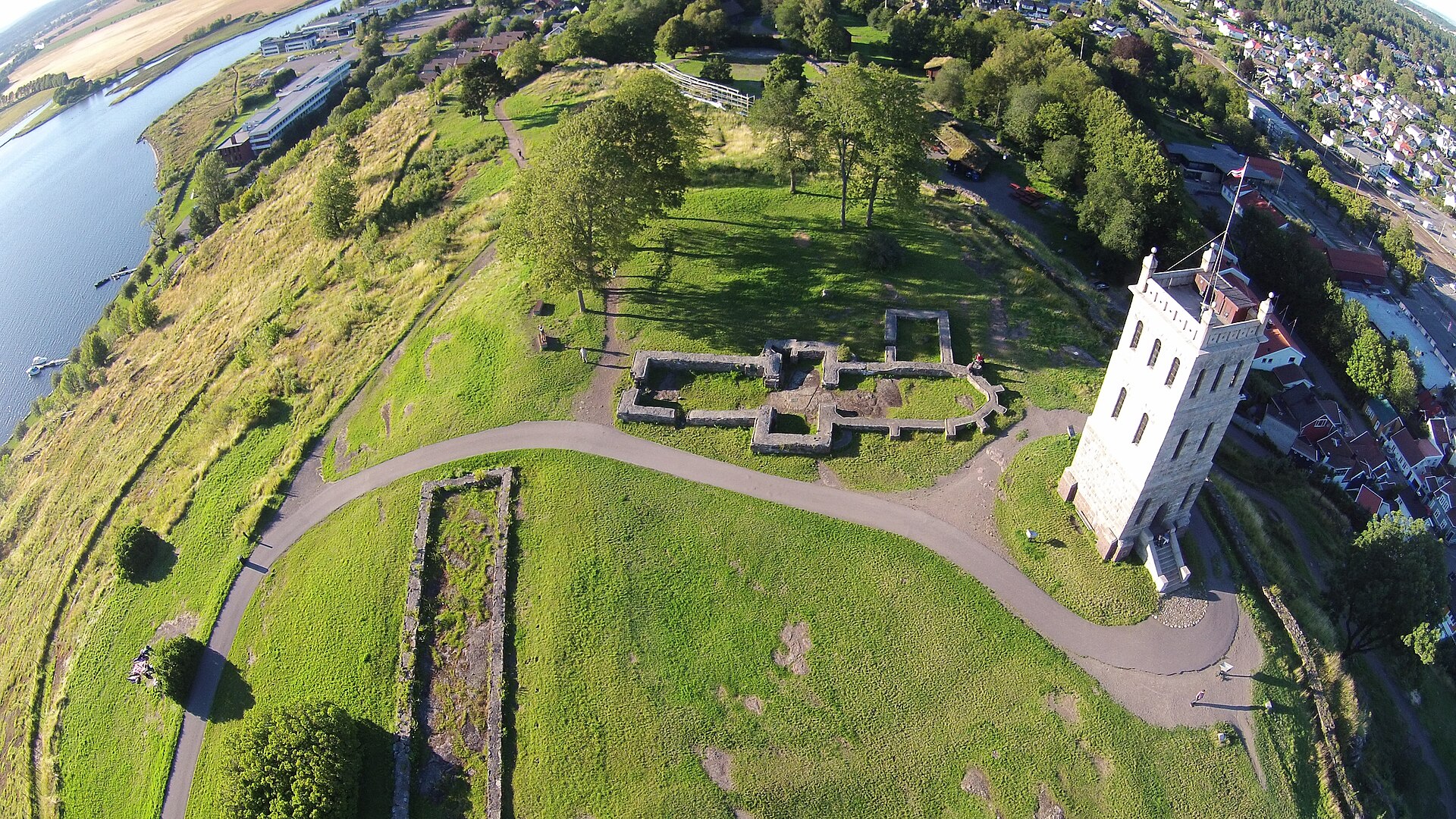
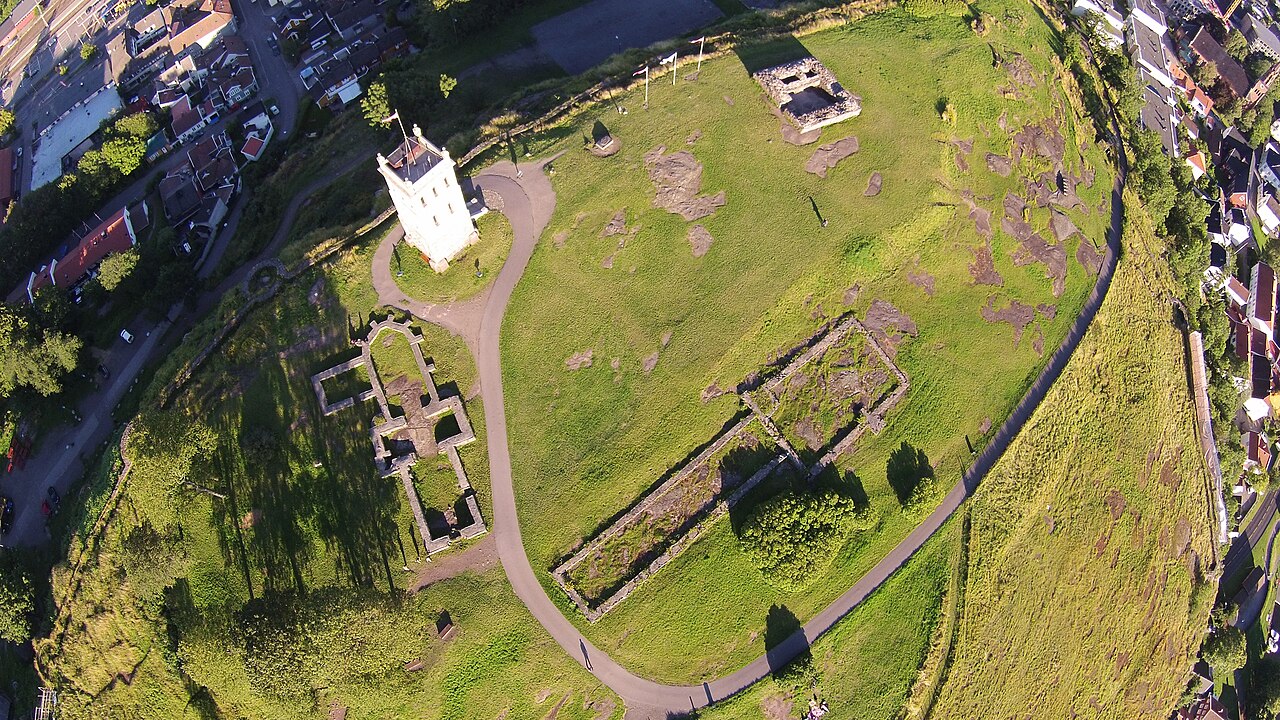
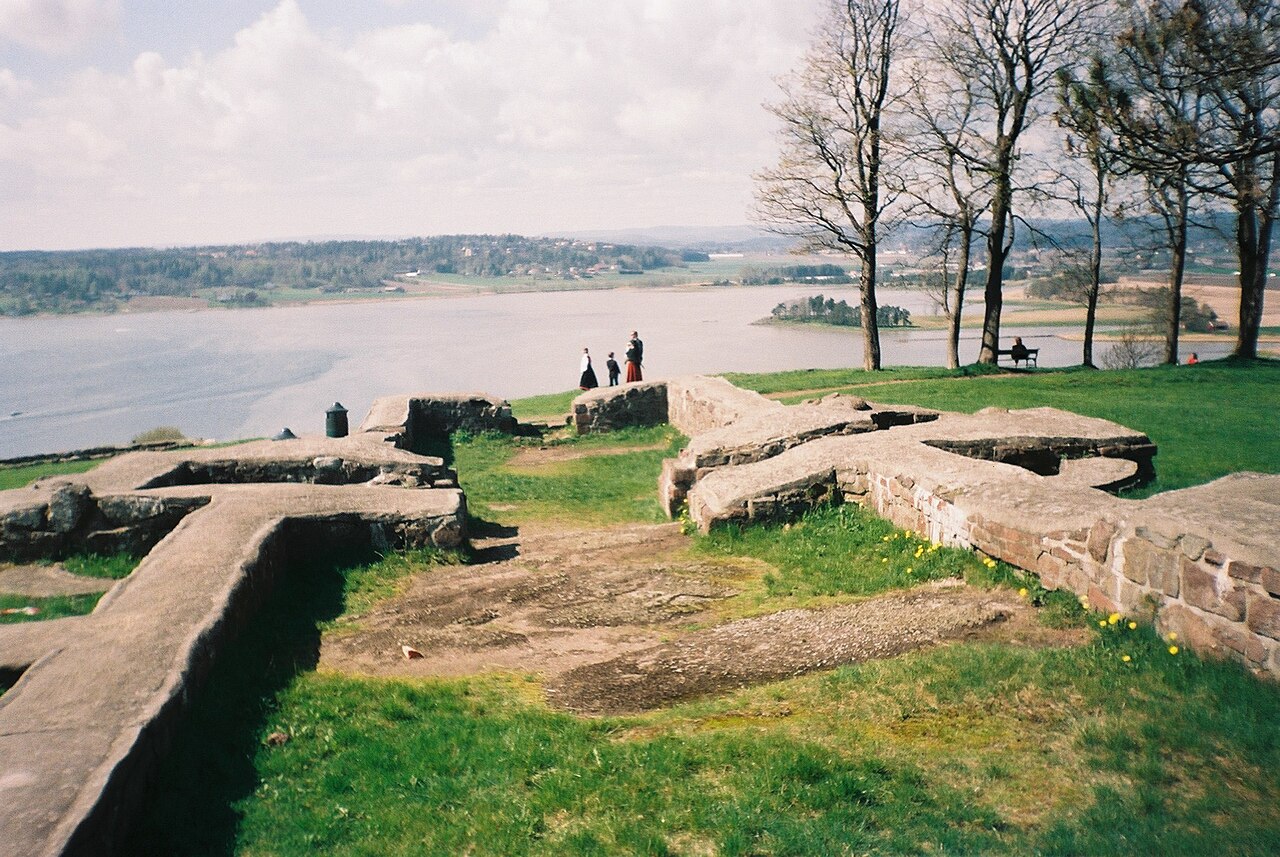
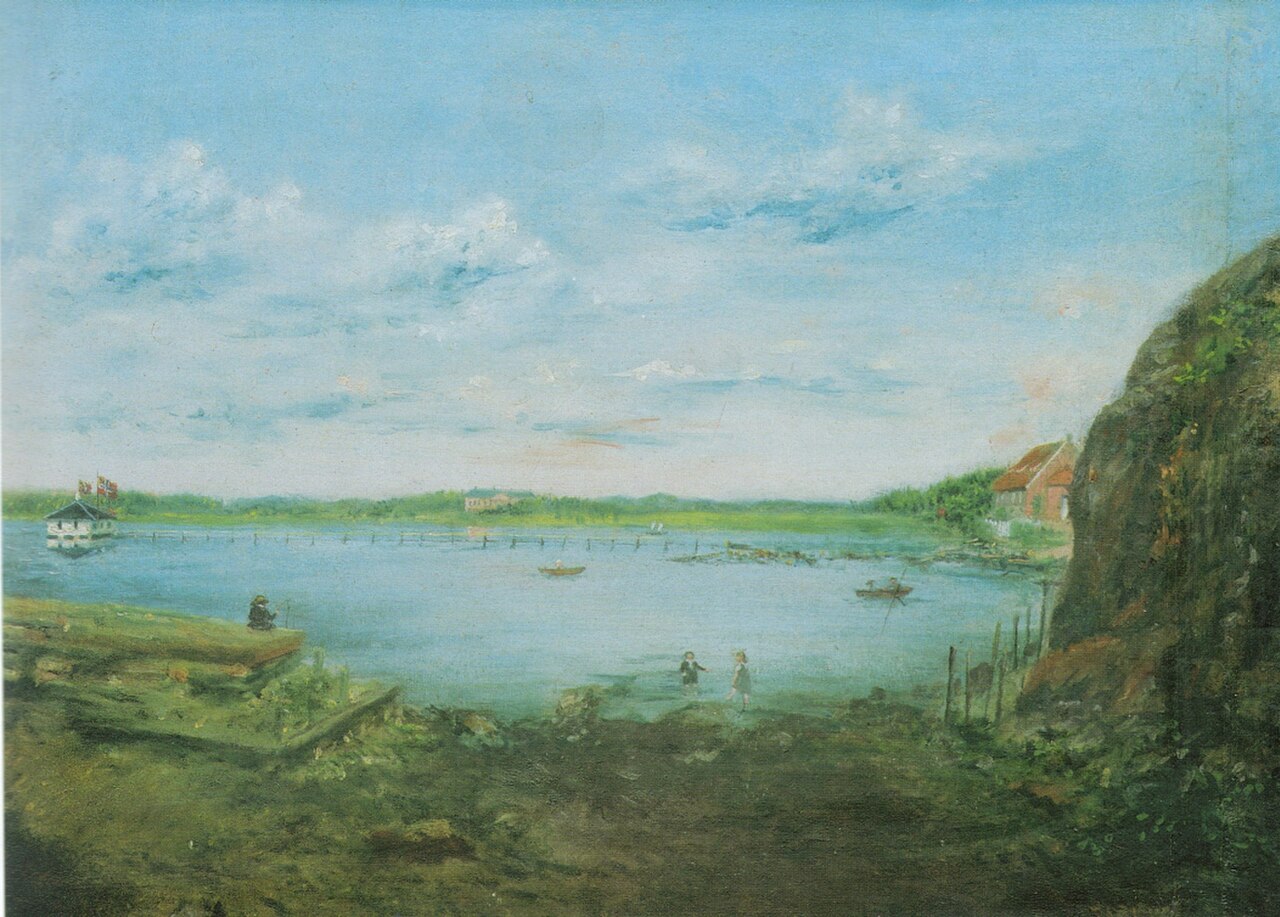
Go up the hill today and there is almost nothing left of any of it. A few low courses of stone in the grass where Norway's greatest castle stood; the outline of a wall, the stump of a tower, the footprint of the church. Crowning the rock is a tower — but a young one, raised in 1888 as a memorial to what was lost, carrying the gilded signatures of three modern kings and a line cut in stone in 1871: “May the town which stands on this site prosper for another thousand years.”
But climb to the ledge and look out, and the thing that actually survived is right in front of you. The fjord is exactly where it was when the Ynglings watched it for sails. The harbour still works below. And the town — Tønsberg, the oldest in Norway — is still there at the foot of the rock, going about an ordinary day, as it has without a break for eleven hundred years. The castle is gone. The kings are gone. The thing they were all guarding — the town, the people, the life at the foot of the hill — is the part that lasted.
And maybe that is the truest thing the green hill has to say. It is no forgotten ruin behind a fence — it is one of the best-known places in Tønsberg, and has been for generations: people climb it for the view, take their photographs from the ledge, sit in the grass where the great hall once stood. At its foot runs Nordbyen, a lane of old wooden houses among the oldest left standing in the oldest town in Norway, in the shadow of the king-rock. That is what becomes of a place where kings were once made and unmade: in the end, the hill outlived every one of them. The dynasty is dust, the great castle is grass, and the rock that made the kings of Norway is still standing — and it belongs now to the town at its foot. Not a fall. A kind of peace. The crown went quiet, and the town it was raised over simply kept on living — which is, when you think about it, exactly what the stone-cutter wished for it in 1871.
.jpg)
.jpg)