Queen of the sea
The name is older than the town. Visby is Vi and by — the holy place and the village — a heathen shrine on a shore where the Gotlanders, the Gutar, had beached their trading boats since before the Viking age; the oldest huts dug up here are radiocarbon-dated to the seventh century. A natural harbour, fresh springs, and a position dead in the centre of the Baltic did the rest. By the thirteenth century Visby was regina maris, queen of the sea: the great emporium where the goods of Novgorod and the goods of the West changed hands, rich enough to strike its own coin.
Two things a medieval town almost never had, Visby had. It wrote its own law — the Visby town law inside the walls, and, carrying its name across the whole sea, the Visby sea-law, the maritime code that much of the Baltic came to sail by and that shaped the trading rules of Novgorod and Riga. And it grew a colony of German merchants so wealthy and so self-governing that the town became, in effect, two towns sharing one harbour: the Gotlandic islanders of the old countryside, and the Hanseatic Germans who did the long-distance trade. For a while the arrangement made everyone rich. Then it built a wall between them.
A wall between two peoples
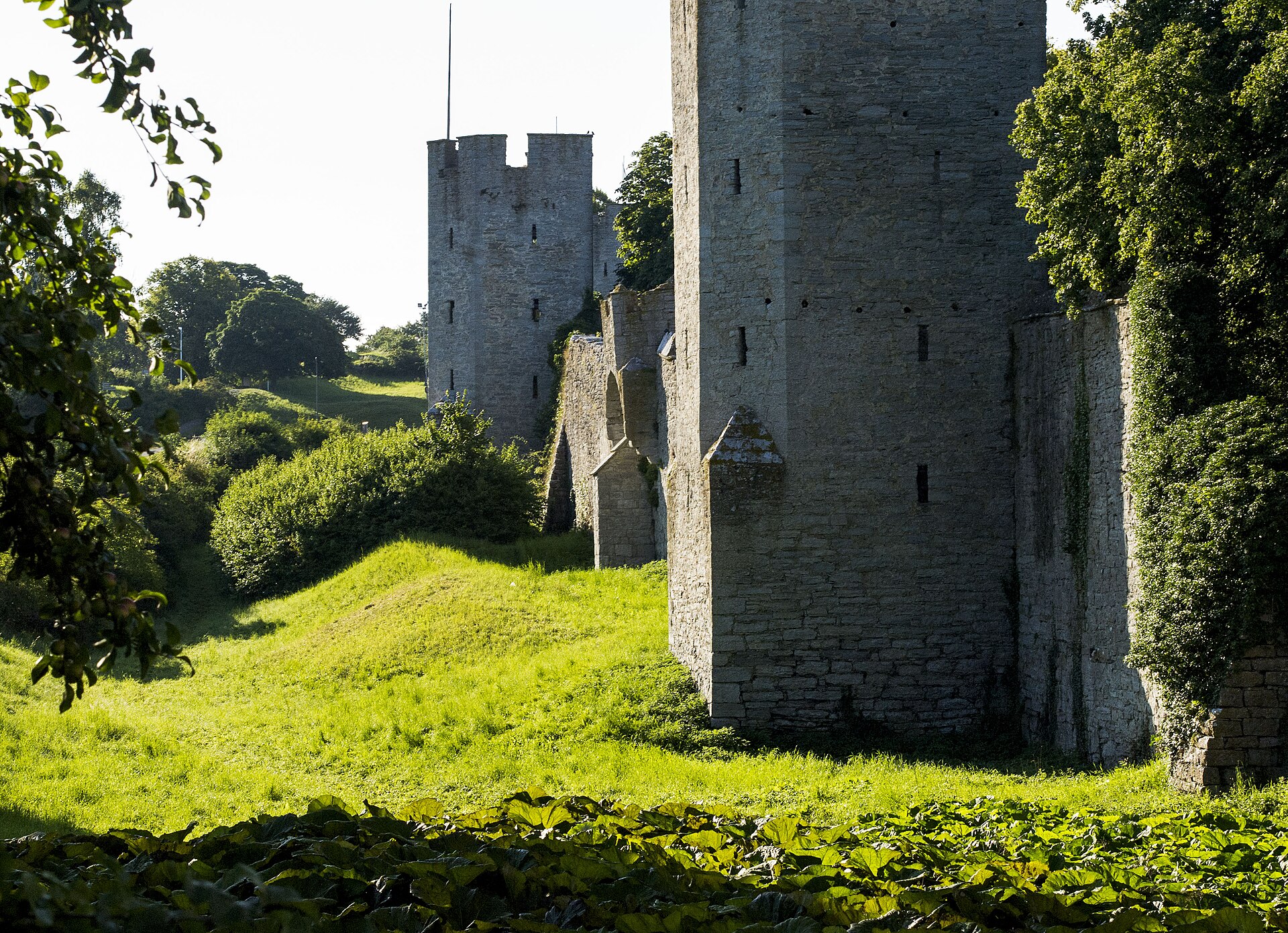
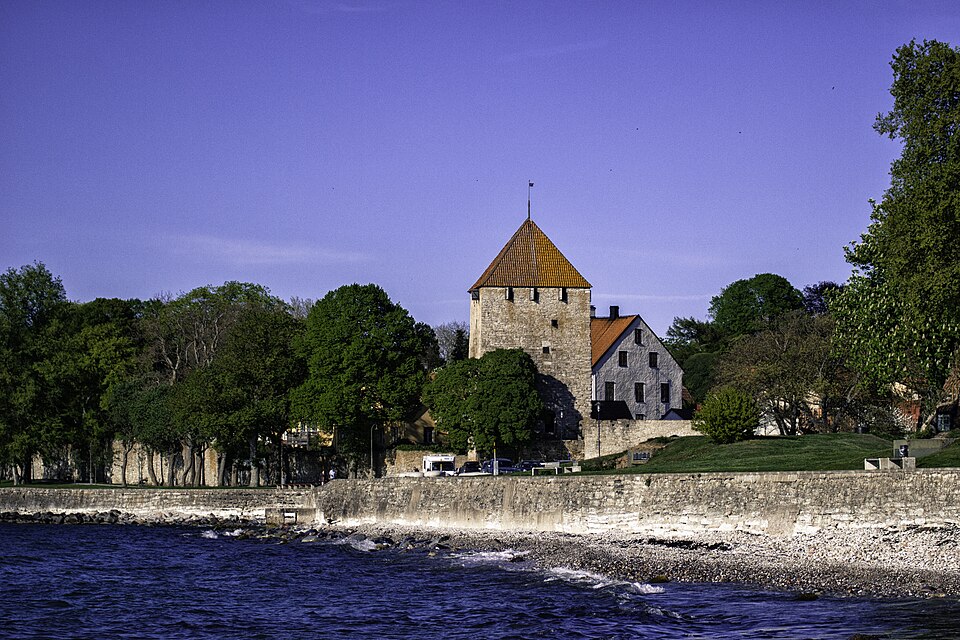
The wall is the reason Visby still looks medieval, and it began, at least in part, as an act of exclusion. Around the 1270s the German burghers started to ring their town in limestone — an extraordinary thing to do in the medieval North, where almost no town had a full wall; in all of medieval Sweden only Visby, Stockholm and Kalmar ever built one. It was raised in two great efforts: a land-facing wall five or six metres high in the 1270s and 1280s, then heightened by another three or four metres in the 1350s, until it ran some three and a half kilometres and carried close to thirty tall towers with saddle-ridged roofs, open at the back toward the town. The oldest piece of all is the Kruttornet, the Powder Tower — a blunt limestone keep guarding the old harbour mouth, dated to around 1160, older than the wall itself and often called the oldest secular building in the Nordic countries.
But a wall keeps people out as much as it keeps enemies out, and the people it kept out were the Gotlandic farmers. The German merchants inside wanted the island's trade to pass through their hands and their market; the country people wanted to sell where they liked. When a Hanseatic decree in 1287 forced all rural trade through Visby, the wall itself became the grievance, and in 1288 the island fell into civil war — burghers against farmers, settled only when the king of Sweden fined the townsmen for having walled their town against his will. The line was drawn: the Germans and their money inside the stone, the Gotlanders and their fields outside it. Seventy-three years later that line would decide who lived and who died.
The day the countryside died
In July 1361 the king of Denmark, Valdemar IV "Atterdag", came for Gotland. Why he came, and what it would cost him, belongs to his own story; what happened here is simpler and worse. His was a professional army — mounted knights, German mercenaries in plate and mail, veterans of the previous summer's conquest of Scania — and it landed on the west coast around the twenty-second of the month. The island rose against him in its old militia divisions, and was beaten in the interior, in the mire at Mästerby, before it ever reached the town. What was left of the levy made its stand on the twenty-seventh of July, just outside the landward wall, on the grazing-ground of the Solberga convent that Gotland still calls Korsbetningen — the field of the cross.
It was not a battle. It was professionals killing amateurs. The Gotlandic army was a peasant levy, and the bones in the ground prove what it was made of: at least a third of the dead were boys and old men, some with old healed wounds, some plainly unfit — the last men the island could put in a line. Valdemar opened with crossbows and closed with the sword, and in a single afternoon some eighteen hundred Gotlanders were killed, against perhaps three hundred of his own. And behind them, the gates of Visby stayed shut. The Hanseatic town, walled and rich, did not march out to save the countryside; it kept to its stone and negotiated its own surrender. Two days later the council opened the gates, and the town was spared. It was never burned. That has to be said plainly, because half the world believes the opposite: the farmers were slaughtered, and the town was ransomed and left standing.
.jpg)
Buried in their armour
The dead of the twenty-seventh of July lay on a summer field, too many to bury with any care and too many, in the July heat, to strip. Normally the victors of a medieval battle took the armour off the fallen — it was worth a fortune. At Visby they could not work fast enough, and so hundreds of Gotlanders were tipped into the mass graves at Korsbetningen still in their mail: shirts of riveted rings, coats of iron plates, and above all the mail coif, the hood of rings that a poor farmer often wore with little else beneath it. That accident of heat and haste made this ground the richest source of medieval armour in Europe — armour recovered on the very men who died in it.
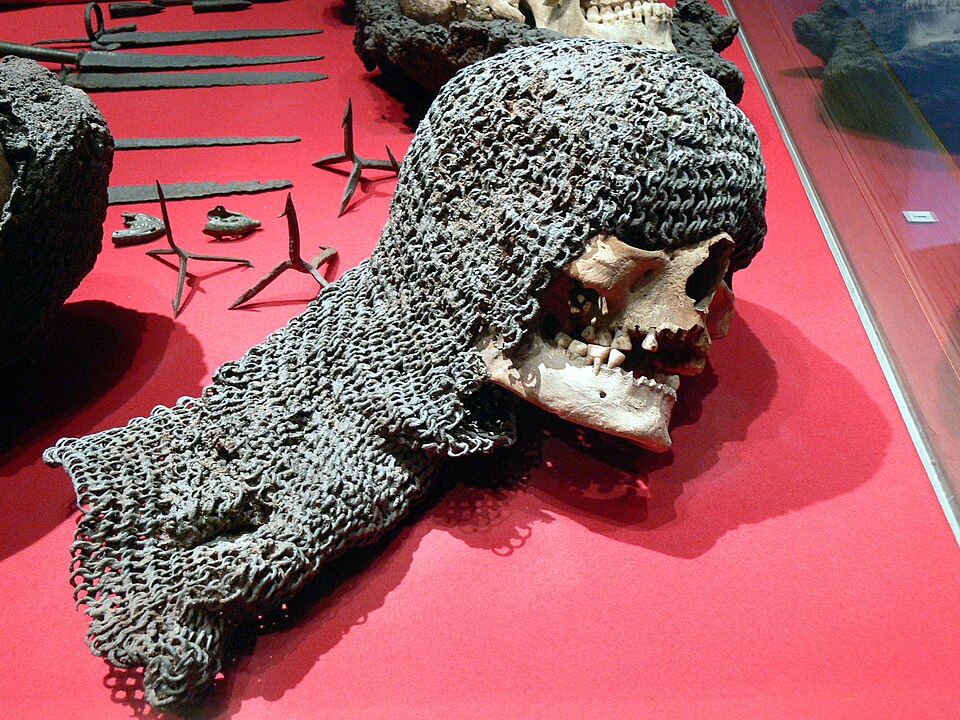
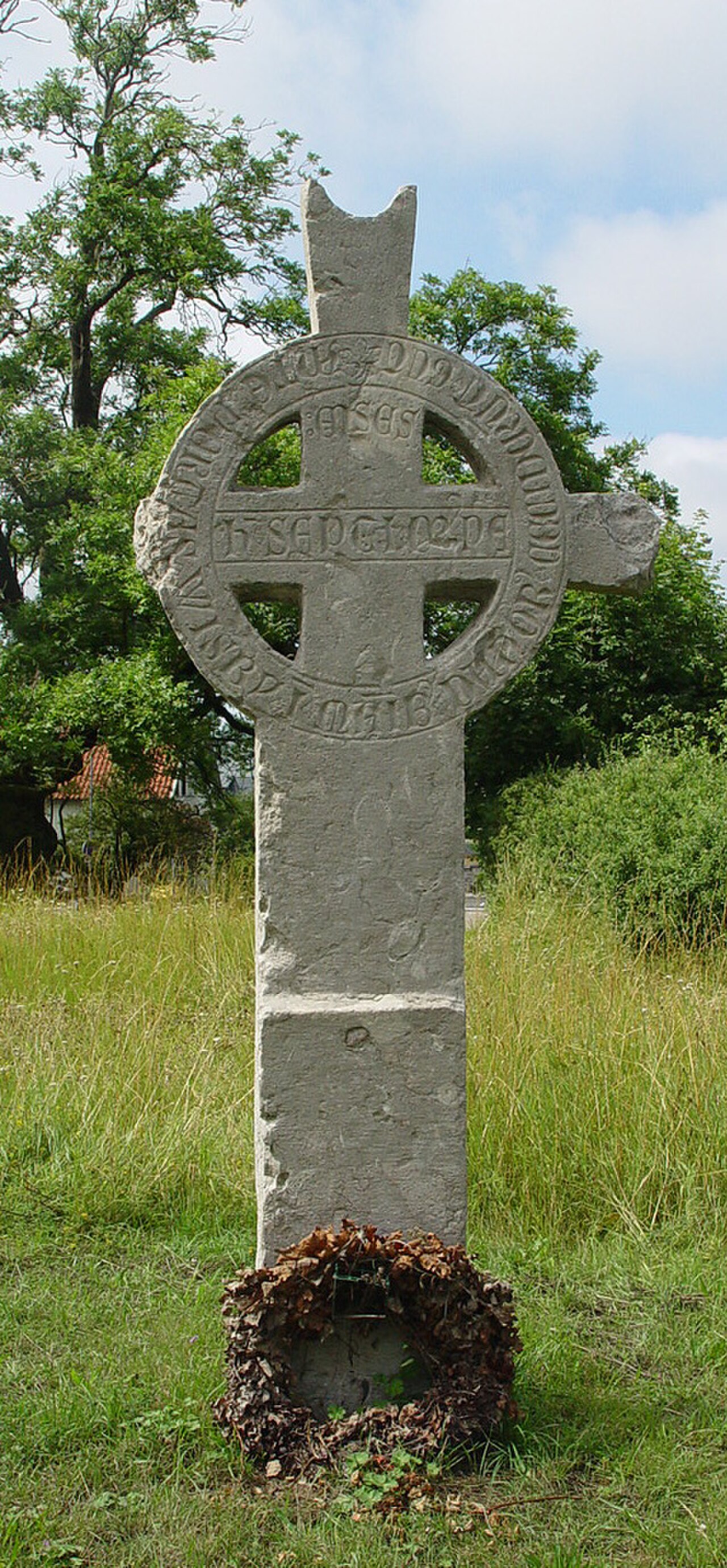
When the graves were opened — first in 1905, then in the great excavations of the 1920s that Bengt Thordeman published in a book still cited today — the bones told the whole story without a word. More than four hundred and fifty wounds from swords and axes, a hundred and twenty-six from arrows and crossbow bolts; the blows clustered on the head and the lower legs, where the mail did not reach; one man with both shins cut almost through, seemingly by a single low sweeping stroke; others struck five, six, seven times, cut down and then finished on the ground. The armour and most of the bones are kept in Stockholm; a skull still in its mail coif is displayed in Visby's own museum. And on the field itself still stands the memorial the survivors raised over the graves within a generation of the battle: a grey limestone ring-cross, carved with Christ, bearing a line of Latin that asks for nothing but memory — ante portas Wisby … ceciderunt Gutenses hic sepulti, orate pro eis. Before the gates of Visby the Gotlanders fell; here they are buried; pray for them.
Pirates, orders, and the last fire
Visby's greatness was already fading when Valdemar came — Lübeck's ships had learned to sail straight past Gotland to Novgorod, and the town's century as the warehouse of the Baltic was closing. The conquest was followed by a long unravelling. In the 1390s the island became a pirates' nest: the Victual Brothers, privateers who had begun by running food into besieged Stockholm and ended as the terror of the sea, seized Gotland and made Visby their headquarters until the Teutonic Order threw them out in 1398. Then the deposed union king Erik of Pomerania built himself the castle of Visborg on the town's south-west edge and, from it, ran a piracy of his own across the Baltic — but that decade belongs to his story.
The blow that ended Hanseatic Visby was fire after all — not Valdemar's, but Lübeck's. In 1525, in a Danish war of succession, a Lübeck fleet anchored deliberately north of the walls, in the dead angle where Visborg's guns could not reach, shelled the town and stormed it, and the northern quarter burned — taking with it the churches of St Nicolai, the Holy Spirit and St Gertrude. After that Visby was a Hanseatic town in name only. Gotland stayed Danish for another century and more, until it passed to Sweden in 1645; the Danes blew up Visborg as they left the island in 1679, and left its stumps above the harbour, where they still stand.
.jpg)
A town of roofless churches
At its height Visby raised churches the way a rich town does — perhaps sixteen inside and around the walls, for a population that would be a small town today. The Reformation and the decline emptied almost all of them. Only one still stands whole and holds services: Sankta Maria, the cathedral, begun in the twelfth century as the church of the German merchants and consecrated in 1225, its three towers still over the roofs. The rest became what a town with no money does with buildings it no longer needs — barns, animal pens, stone quarries — and slowly lost their roofs to the sky.
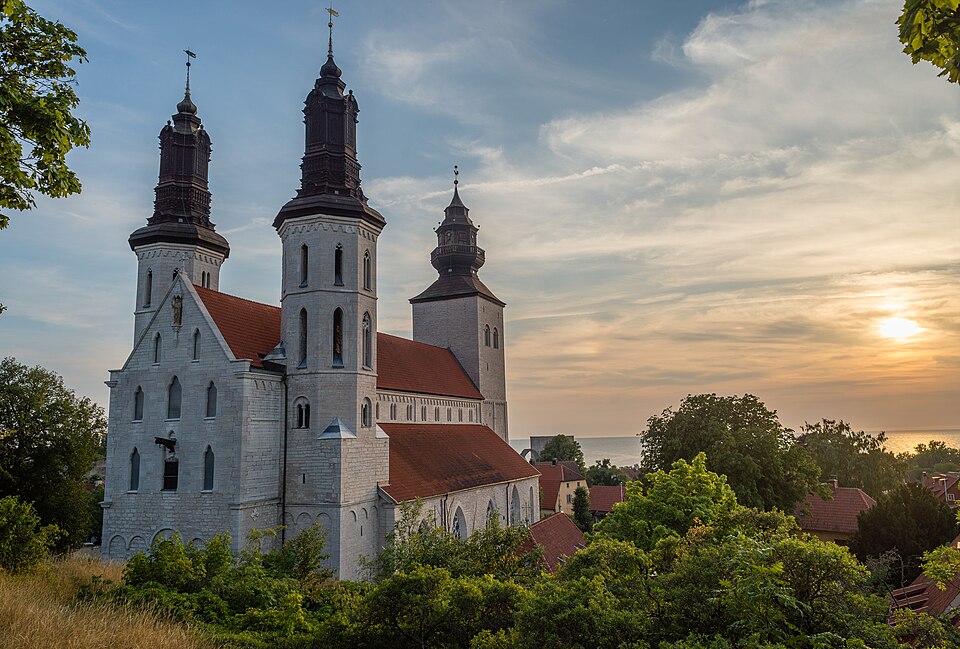
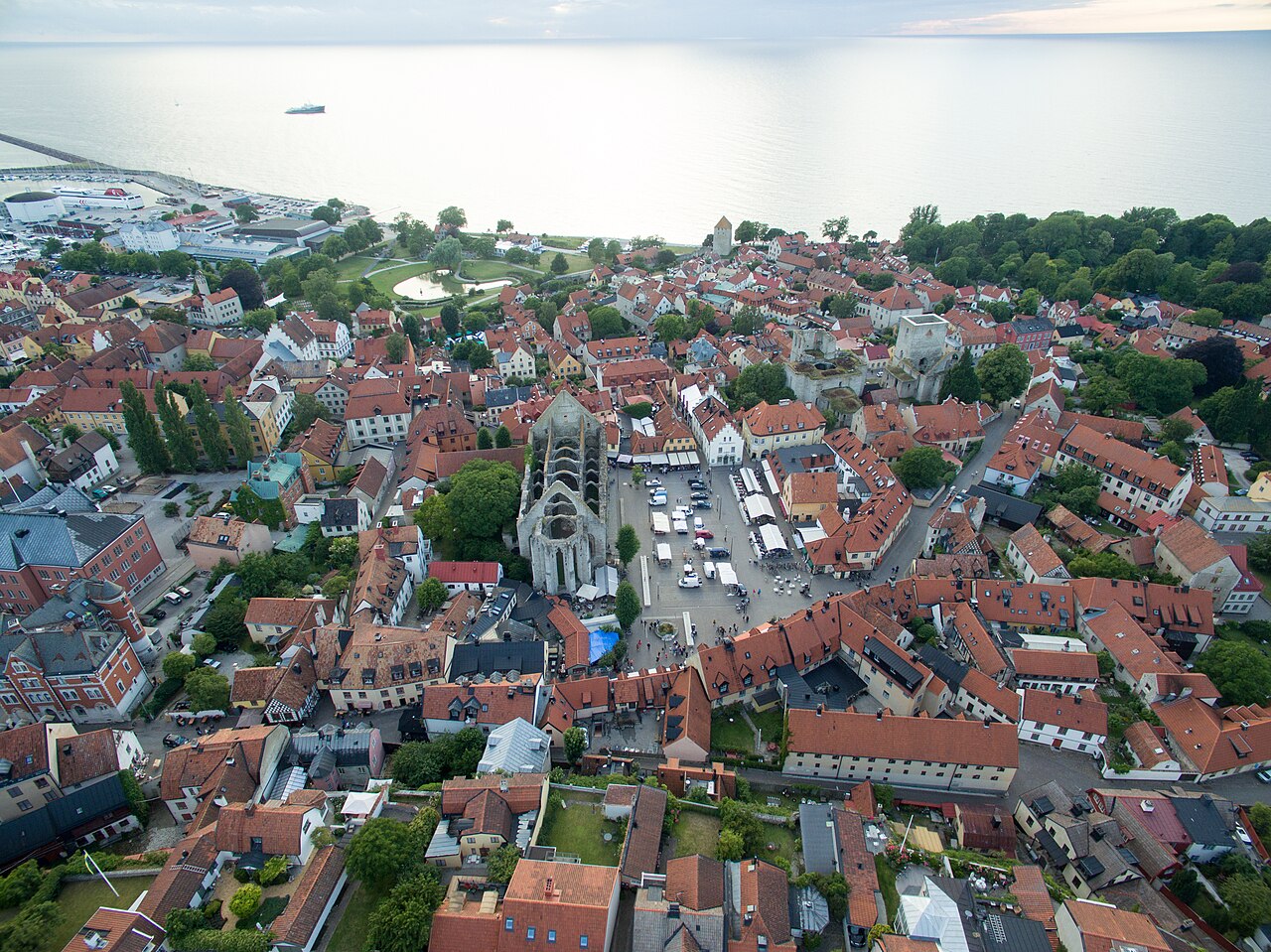
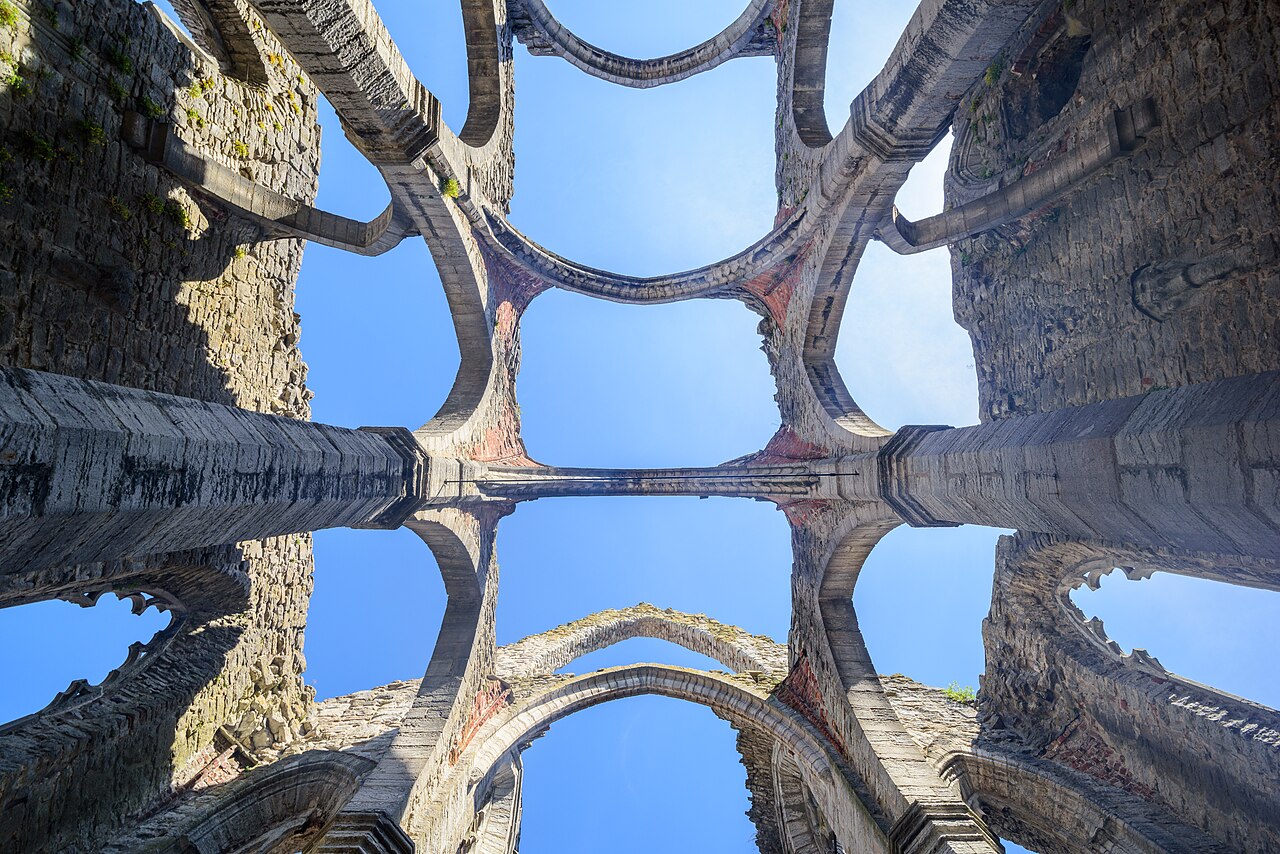
What was left is something almost nowhere else in the North still has: a dozen medieval churches standing roofless and open, in the middle of a living town. Sankta Karin rises straight off the main square, the grandest of them, a Franciscan friary church whose brick vaults — the one thing in Visby not built of the island's grey limestone — fell in long ago and left its pointed arches open to the weather. St Nicolai, the great Dominican church, is the largest ruin of all. Helge And, the Church of the Holy Spirit, keeps its strange two-storey octagon. A royal decree of 1810 was the first to protect them, when Sweden had begun to see that a ruin, too, is worth keeping. They are the reason for the second half of the town's old name.
The town of roses and ruins
Some time around the turn of the twentieth century, as the Romantic taste for ruins met the first picture postcards, Visby acquired the name it still carries: rosornas och ruinernas stad, the town of roses and ruins. No single poet coined it — it grew out of an age that had learned to love a ruin, and out of the roses that climb the grey stone all summer. What that age was really admiring, though it did not always know it, was the work of poverty. Visby survived whole for one unglamorous reason: after the Middle Ages it was too poor and too far out to sea to tear itself down and build something newer. Its two hundred medieval stone warehouses, its street plan, its wall and its ruins were never cleared away, because nothing richer ever came to replace them.
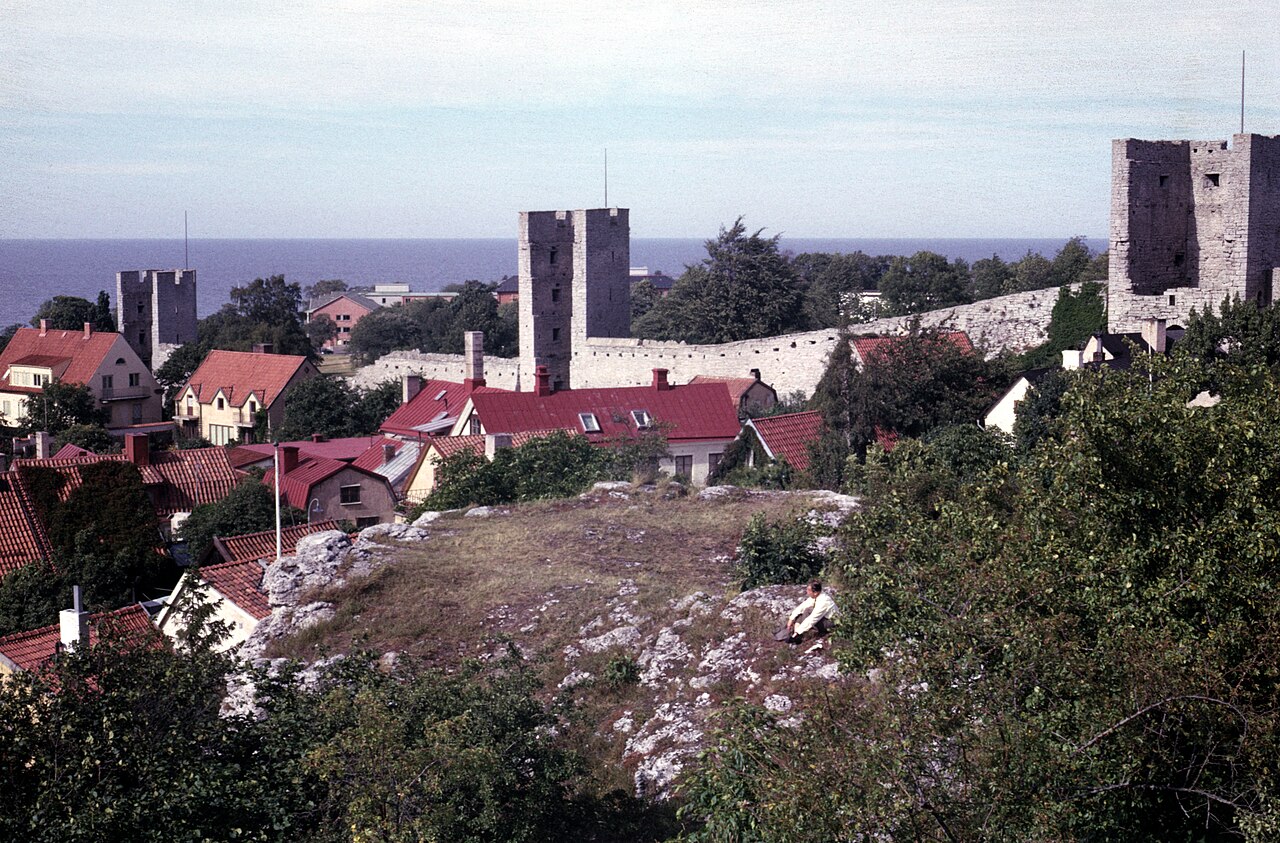
So the accident held. In 1995 UNESCO inscribed the Hanseatic Town of Visby on the World Heritage List — the best-preserved fortified trading town in northern Europe, a place that still wears, almost whole, the shape the thirteenth century gave it. Every August the walls fill for Medeltidsveckan, the medieval week, and forty thousand people come to play at the Middle Ages inside the real thing. It is worth standing once at the Korsbetningen cross, out past the wall, and then walking back in through a gate the farmers never reached — into the town they died in front of and were shut out of, kept whole by the same poverty that killed their island's trade: grey stone, red roofs and roofless churches, the fourteenth century still standing where richer towns pulled theirs down.