The king who did not die of pea soup
Everyone in Sweden knows how Erik XIV died: a bowl of poisoned pea soup in his prison. But the soup enters the record half a century after his death, in a prisoner's manuscript — and when the grave was opened in 1958, the chemists found the poison and no soup. What actually happened is colder, and worse.
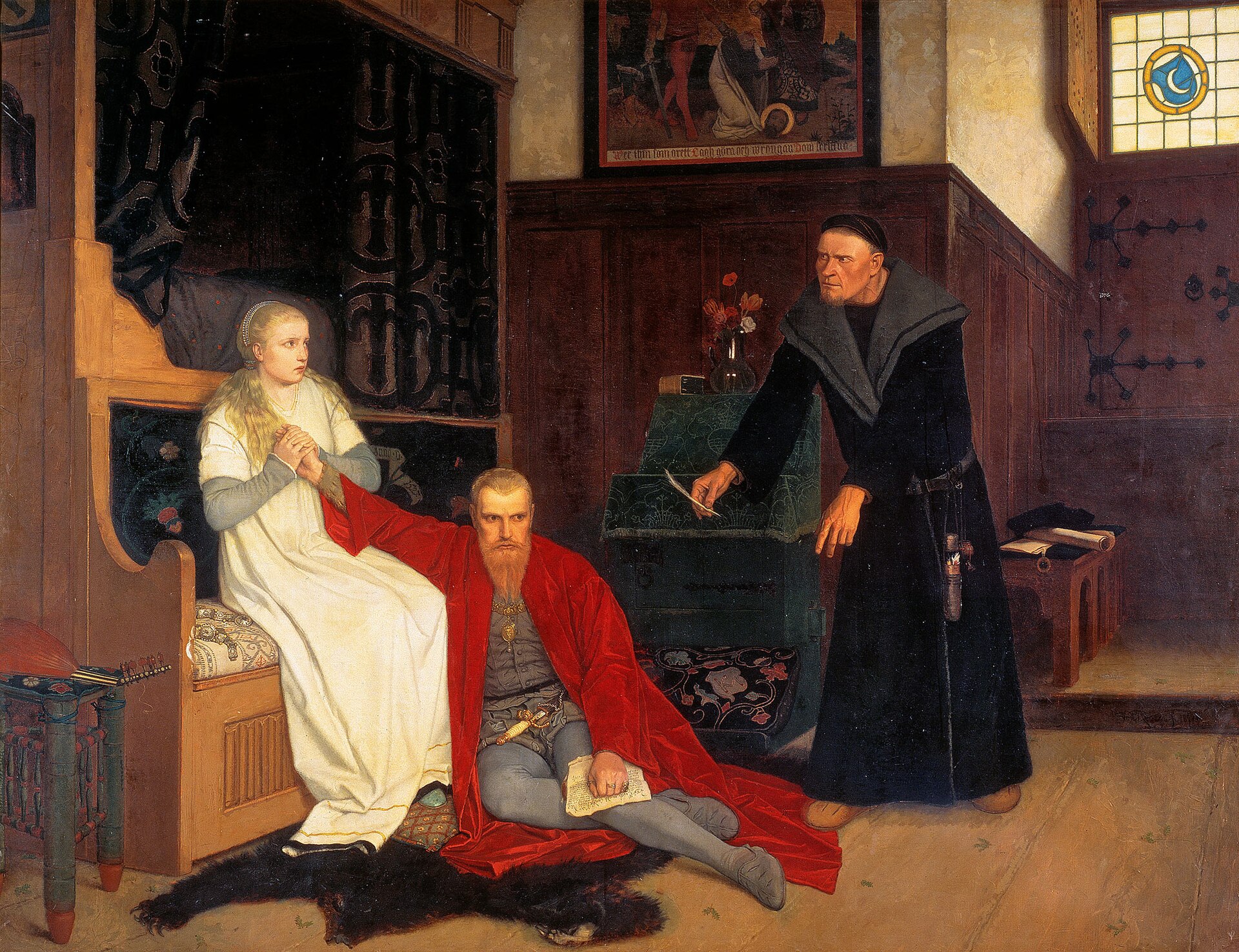
Ask anyone who went to school in Sweden how Erik XIV died, and the answer comes without a pause: poisoned pea soup. The mad king, locked away by his brother, finished off with the national dish. The story is so Swedish it can hardly be improved — regicide served the Thursday way, yellow peas with a pinch of arsenic.
There is just one problem. Nobody alive when Erik died had heard of any poisoned pea soup.
A soup that arrives half a century late
Erik XIV died at Örbyhus Castle an hour or so after midnight on 26 February 1577, forty-three years old, after about a week's illness. The priests at his deathbed described him as lucid. The body was embalmed, carried to Västerås Cathedral and put on display for three days, so that anyone could satisfy themselves that the royal prisoner really was dead. The funeral was kept plain, with no family present. And the writers of the following decades have nothing remarkable to say about any of it.
The soup first appears in the 1620s, and it appears from inside a prison. Johannes Messenius, a historian convicted of treason, sat locked in Kajaneborg castle in the interior of Finland, writing his great history of the North. It is in his manuscript that the pea soup surfaces for the first time: on the day of his death, Messenius writes, Erik took the poison "in the pea soup that was served". And then he adds the reservation that should have travelled with the story for four hundred years and never did: so it is told.
Read that again. The myth's very first source — a prisoner writing half a century after the event — marks his own sentence as hearsay. He even gets the date of death wrong: he wrote 25 February; Erik died on the 26th. At the moment of its birth, the soup already carried its own warning label.
Then the story does what stories do: it travels, and the warning label falls off. Messenius' manuscript was not printed until 1700–1705. Before that, in 1686, Samuel von Pufendorf became the first to put the poisoning into print. And when Carl Grimberg wrote Svenska folkets underbara öden in the 1910s — the book a whole generation of Swedes learned their history from — the soup was in place, wrapped in Grimberg's own caveat, "according to legend", which readers forgot faster than the text. Messenius even supplied the poison with a hand: Filip Kern, a man skilled in medicines, who had been staying at Örbyhus.
What the papers say
What makes the soup unnecessary is that the real story is documented — not in legend but in state papers, and they are worse than any legend.
As a deposed king, Erik was more dangerous alive than dead. As long as he breathed there were men who wanted him back on the throne: a conspiracy in his favour was uncovered as early as 1569, the Mornay plot of 1574 aimed to cut down Johan III during a sword-dance performance, and that same autumn riders and peasants marched on Örbyhus to free him. So around the prisoner, paper by paper, his brother built the machinery of death in advance.
In 1569 Johan obtained a statement from the archbishop and two bishops that killing a king could carry scripture's blessing: Solomon, after all, had his brother Adonijah put to death. In 1572 Erik's guards received written authority to take his life if anyone tried to free him. On 10 March 1575 the council passed formal judgment on the deposed king. And on 19 January 1577, a good five weeks before the death, Johan renewed the killing instruction.
One of the letters survives. On 21 June 1573 Johan wrote to the councillor guarding Erik at Västerås Castle, and the words lie in the Swedish National Archives to this day:
En dryck aff Opium eller Mercurium så starck att han öffwer någre thimmer icke kan leffwe.
A drink of opium or mercury, so strong that he cannot live more than a few hours. If the prisoner refused, the drink was to be forced down him, or the bedding used. First, he was to receive the sacrament.
Note what none of the documents mention: pea soup. The plan was never a meal. The plan was a drink.
In February 1577 fresh rumours of conspiracy reached Johan, this time from Småland. At about the same time, Erik fell ill. On 24 February word of the illness went to Johan; in the small hours of the 26th, Erik was dead. When the news reached Duke Karl, the youngest of the brothers, on 1 March, he wrote to Johan with a warning: not one councillor had been present at the deathbed, and rumours threatened to spread. Johan Henriksson, the secretary given charge of the prisoner shortly before the death, received a handsome raise the following year, and a judgeship. Karin Månsdotter, Erik's queen, had by then spent four years in mild captivity at Turku Castle; at his death she was set free. And at the riksdag of 1605 came the closest thing to an admission the state ever produced: Karl, by then king himself, accused an old councillor of having endorsed that Erik "should be poisoned in his prison" — and added: "which also came to pass".
What the grave said
For 381 years the question stayed open. Well into the twentieth century there were historians who kept the door open to a natural death; the sources could be read either way. Then came the restoration of Västerås Cathedral, and with it an idea from the county governor, Ragnar Casparsson: open the grave and ask the body.
On 20 January 1958 the coffin was lifted into the sacristy. The examination was led by Carl-Herman Hjortsjö, professor of anatomy at Lund, together with the former National Antiquarian Martin Olsson. Under the linen cloth over the face lay the king, long beard and moustache, looking like his portraits. X-rays showed that his left upper arm had been broken in two places — healed damage from the prison years. On Sunday 26 January, between one and six o'clock, fifteen thousand people filed past the open coffin. The same town that in 1577 had been given three days to see that the prisoner was dead queued up again, to make certain one more time.
Sixty samples were taken. There was arsenic in the hair, in the nails, in what remained of the soft tissue, in lethal concentrations in the remains of the internal organs — and in quantity beneath the body, where it had leached during decomposition. It was in the shroud and in the original wooden coffin. Arsenic had not been used in the embalming, and the doses were far beyond anything medicine would have given. The conclusion was phrased with all of science's caution, and still fell like a verdict:
Fynden i sin helhet ge fullt stöd åt antagandet, att Erik XIV blivit förgiftad med arsenik.
The findings as a whole give full support to the assumption that Erik XIV was poisoned with arsenic. Casparsson put it more freely: with probability bordering on certainty, King Erik was murdered in his prison.
And the soup? The chemists analysed even the 380-year-old stomach contents. They found the arsenic. Of pea soup, not a trace. The myth was given its one chance of laboratory confirmation, and the laboratory answered: poison, yes. Soup, no.
Why pea soup, of all things?
Because a murder needs a picture. "A drink" is abstract; a bowl of soup steams. And the peas were already on the table when the legend was born: by 1620 the hospital of Västerås — that town, of all towns — was serving pea soup on Thursdays, before Messenius had even written the soup down. The Thursday habit is usually explained by Catholic fasting logic, no meat on Friday and so pork and peas the day before, and in any case it has nothing to do with Erik. When a story looks for something to hold on to, it holds on to the familiar; the poison moved into the dish already standing on everyone's table.
Perhaps that is also why the myth refuses to die: it is more human than the truth. A poisoned soup is a kitchen crime — one cook, one bowl, one moment of weakness. What the archives show is something else: a state that for years kept a signed death warrant hanging over a prisoner, renewed and co-signed by councillors, with the bishops' Bible verse as its receipt, and that finally had it carried out so quietly that posterity would argue about it for nearly four centuries. The legend gives the poison a hand to hold it. History gives it a filing number.
If you want to see how Sweden chose to remember him, go to Västerås Cathedral. There Erik lies in a sarcophagus of Carrara marble, given to him a good two hundred years after his death — and on its lid rests a gilded funeral crown that Gustav III had fetched from Johan III's burial monument in Uppsala. The crown on the victim's grave is taken from the brother's — the brother who signed the killing instructions. History never needed the soup. It already held more irony than any legend would dare invent.
The next time someone tells you Erik XIV died of poisoned pea soup, remember where the story was born: in a prison cell in Finland, half a century after the night of his death, with an author who was careful to include four small words.
So it is told.
Read more on Aikapolku
Sources
- Erik XIV — Svenskt biografiskt lexikon (Ingvar Andersson; in Swedish)
- Erik XIV:s död – kungamord med stöd i Bibeln — Populär Historia (in Swedish)
- Västerås 1958 – Erik XIV:s lik beskådas i öppen gravkista — Populär Historia (in Swedish)
- Johan III's letter, 21 June 1573 (Riksarkivet SE/RA/1113/13) — Stockholmskällan
- Carl Grimberg, Svenska folkets underbara öden II — Project Runeberg (in Swedish)
- Casparsson, Ekström & Hjortsjö, Erik XIV: en historisk, kulturhistorisk och medicinsk-antropologisk undersökning i samband med gravöppningen 1958 i Västerås domkyrka (Norstedts, 1962)
- Erik XIV — Wikipedia
- Mördades Erik XIV av förgiftad ärtsoppa? (Dick Harrison) — SO-rummet (in Swedish)
- Ärtsoppa (the Thursday tradition) — Wikipedia (in Swedish)
- Västerås domkyrka (the sarcophagus and funeral regalia) — Wikipedia (in Swedish)
- Georg von Rosen, Erik XIV (1871), Nationalmuseum — Wikimedia Commons