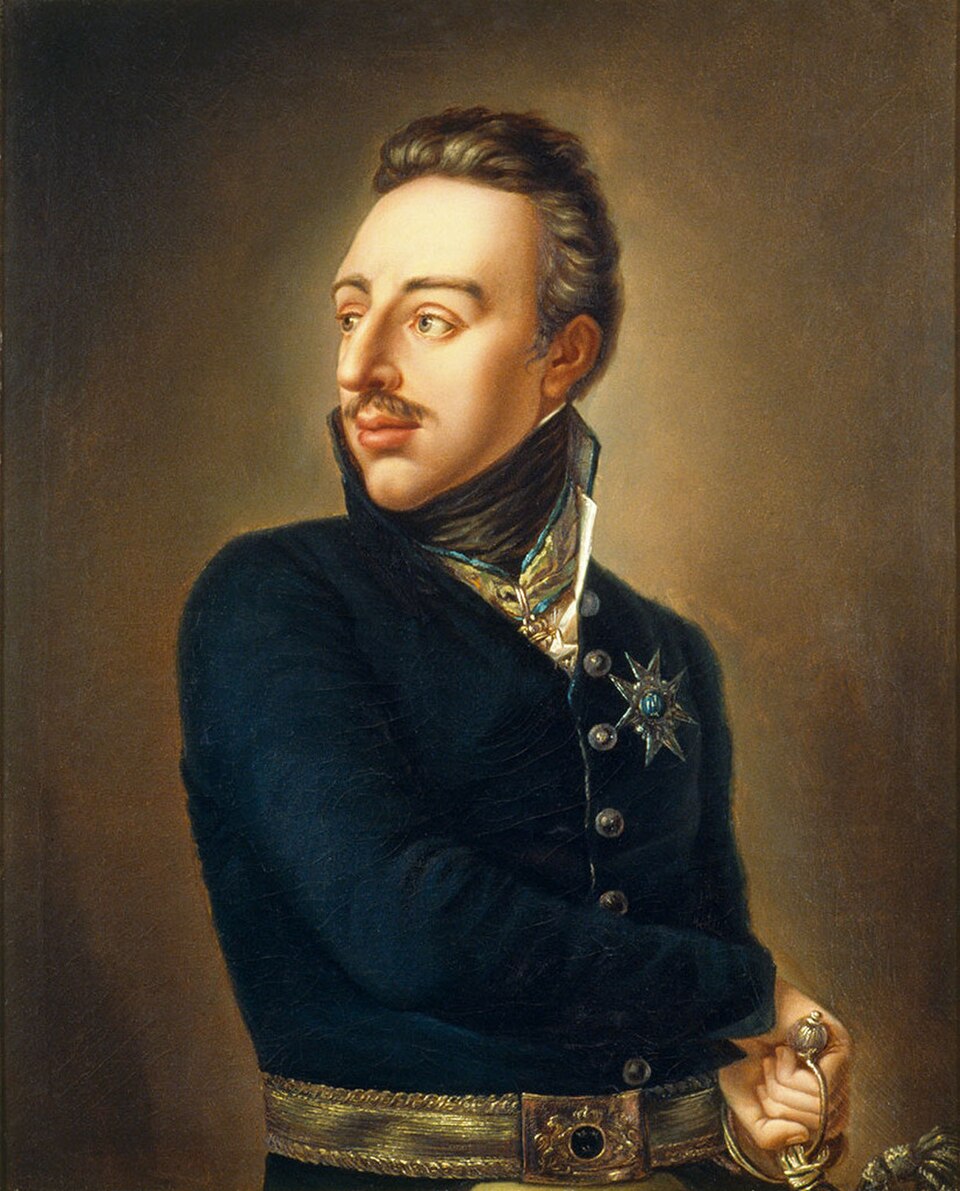
He was the son of an assassinated father, Gustav III, and he came to the throne marked by it — pious, rigid, sure of his own righteousness where his father had been all charm and performance. As Europe convulsed under Napoleon, Gustav IV Adolf set himself against the French emperor with a stubbornness close to crusade, and bound a small kingdom to the wars of the great powers with no strength to match his certainty.
It cost him everything. The war with Russia in 1808–09 turned into a defeat that carried off the realm's eastern third, and the stiff, unbending king — the man who had never given an inch at anything — broke utterly beneath it. In March 1809 his own officers turned against him, seized him, and brought him to Gripsholm, where he was forced to sign away his crown. He could not have known that this very defeat held the seed of something lasting: the Finland he had lost would soon become a country of its own, and that rising belongs, in full, to the castle's own story.
What came after is the cruellest part. His whole line was set aside with him — the throne passed first to his uncle, then to a French marshal, Bernadotte, whose descendants reign in Sweden still. Gustav was sent into exile, parted from family and country, and spent his last decades wandering Europe under invented names — 'Count Gottorp,' 'Colonel Gustafsson' — a shabby, solitary figure in a plain brown coat, the king no one would let him be. He died in 1837 in a cheap inn in St. Gallen, in Switzerland, alone. The man who had lost a country had, in the end, lost even his own name.